Best Way to Ventilate a House With Fans
Energy-efficient homes -- both new and existing -- require mechanical ventilation to maintain indoor air quality. There are 4 basic mechanical whole-house ventilation systems -- exhaust, supply, balanced, and free energy recovery.
Comparing of Whole-House Ventilation Systems
| Ventilation System | Pros | Cons |
| Frazzle |
|
|
| Supply |
|
|
| Balanced |
|
|
| Energy Recovery & Heat Recovery Ventilators |
|
|
Exhaust Ventilation Systems
Frazzle ventilation systems work by depressurizing your habitation. The arrangement exhausts air from the business firm while make-upward air infiltrates through leaks in the building shell and through intentional, passive vents.
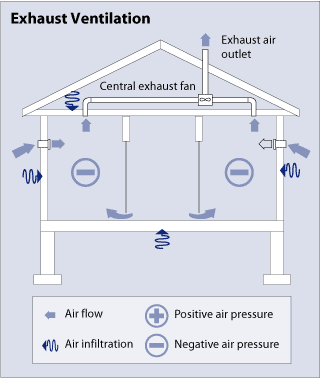
Exhaust ventilation systems are well-nigh appropriate for cold climates. In climates with warm humid summers, depressurization can draw moist air into building wall cavities, where information technology may condense and cause moisture damage.
Exhaust ventilation systems are relatively simple and inexpensive to install. Typically, an frazzle ventilation system consists of a unmarried fan continued to a centrally located, single exhaust point in the house. A ameliorate design is to connect the fan to ducts from several rooms, preferably rooms where pollutants are generated, such as bathrooms. Adaptable, passive vents through windows or walls can be installed in other rooms to introduce fresh air rather than rely on leaks in the edifice envelope. Passive vents may, however, require larger pressure differences than those induced past the ventilation fan to work properly.
I business concern with frazzle ventilation systems is that -- along with fresh air -- they may draw in pollutants, including:
- Radon and molds from a crawlspace
- Dust from an attic
- Fumes from an attached garage
- Flue gases from a fireplace or fossil-fuel-fired h2o heater and furnace.
These pollutants are a particular business when bath fans, range fans, and dress dryers (which also depressurize the home while they operate) are run when an frazzle ventilation system is also operating.
Exhaust ventilation systems tin also contribute to college heating and cooling costs compared with energy recovery ventilation systems because frazzle systems do not atmosphere or remove moisture from the brand-up air earlier information technology enters the business firm.
Supply Ventilation Systems
Supply ventilation systems utilize a fan to pressurize your dwelling, forcing outside air into the building while air leaks out of the building through holes in the vanquish, bath, and range fan ducts, and intentional vents (if any exist).
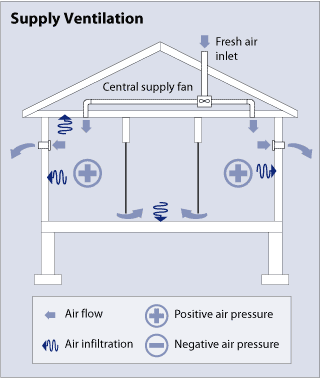
Like exhaust ventilation systems, supply ventilation systems are relatively simple and inexpensive to install. A typical supply ventilation organization has a fan and duct system that introduces fresh air into usually one -- just preferably several -- rooms that residents occupy about (e.g., bedrooms, living room). This arrangement may include adjustable window or wall vents in other rooms.
Supply ventilation systems allow better command of the air that enters the house than frazzle ventilation systems do. Past pressurizing the house, supply ventilation systems minimize outdoor pollutants in the living space and prevent backdrafting of combustion gases from fireplaces and appliances. Supply ventilation too allows outdoor air introduced into the house to be filtered to remove pollen and dust or dehumidified to provide humidity control
Supply ventilation systems work best in hot or mixed climates. Considering they pressurize the house, these systems have the potential to cause moisture problems in cold climates. In winter, the supply ventilation system causes warm interior air to leak through random openings in the exterior wall and ceiling. If the interior air is humid enough, moisture may condense in the attic or cold outer parts of the exterior wall, resulting in mold, mildew, and disuse.
Like exhaust ventilation systems, supply ventilation systems exercise not temper or remove moisture from the make-upwardly air before it enters the firm. Thus, they may contribute to higher heating and cooling costs compared with energy recovery ventilation systems. Considering air is introduced into the business firm at detached locations, outdoor air may need to exist mixed with indoor air before commitment to avoid cold air drafts in the wintertime. An in-line duct heater is another pick, but increases operating costs.
Balanced Ventilation Systems
Counterbalanced ventilation systems, if properly designed and installed, neither pressurize nor depressurize your home. Rather, they introduce and exhaust approximately equal quantities of fresh outside air and polluted inside air.
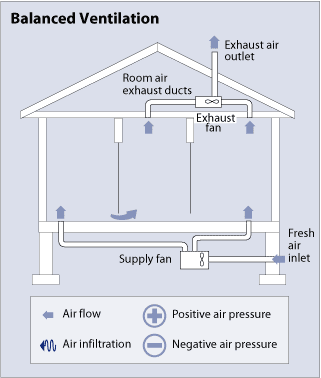
A counterbalanced ventilation system usually has two fans and two duct systems. Fresh air supply and exhaust vents tin can be installed in every room, but a typical balanced ventilation system is designed to supply fresh air to bedrooms and living rooms where occupants spend the most fourth dimension. It also exhausts air from rooms where moisture and pollutants are most often generated (kitchen, bathrooms, and perhaps the laundry room).
Some designs use a single-point exhaust. Considering they directly supply outside air, balanced systems allow the use of filters to remove dust and pollen from outside air before introducing information technology into the house.
Balanced ventilation systems are appropriate for all climates. Because they crave two duct and fan systems, however, balanced ventilation systems are unremarkably more expensive to install and operate than supply or exhaust systems.
Like both supply and exhaust systems, balanced ventilation systems do non temper or remove moisture from the make-up air before information technology enters the house. Therefore, they may contribute to higher heating and cooling costs, unlike energy recovery ventilation systems. Likewise, like supply ventilation systems, outdoor air may demand to exist mixed with indoor air before delivery to avoid cold air drafts in the winter.
Energy Recovery Ventilation Systems
Energy recovery ventilation systems provide a controlled mode of ventilating a home while minimizing energy loss. They reduce the costs of heating ventilated air in the winter past transferring rut from the warm inside frazzle air to the fresh (simply cold) outside supply air. In the summertime, the inside air cools the warmer supply air to reduce cooling costs.
There are two types of energy-recovery systems: oestrus-recovery ventilators (HRV) and free energy-recovery (or enthalpy-recovery) ventilators (ERV). Both types include a rut exchanger, one or more fans to push button air through the automobile, and controls. There are some small wall- or window-mounted models, but the majority are central, whole-firm ventilation systems with their own duct organisation or shared ductwork.
The primary divergence betwixt a heat-recovery and an energy-recovery ventilator is the way the heat exchanger works. With an energy-recovery ventilator, the heat exchanger transfers a certain corporeality of h2o vapor along with heat free energy, while a rut-recovery ventilator but transfers heat.
Because an energy-recovery ventilator transfers some of the moisture from the exhaust air to the usually less humid incoming winter air, the humidity of the house air stays more constant. This also keeps the estrus exchanger core warmer, minimizing problems with freezing.
In the summer, an free energy-recovery ventilator may help to control humidity in the house by transferring some of the water vapor in the incoming air to the theoretically drier air that's leaving the house. If you use an air conditioner, an energy-recovery ventilator generally offers amend humidity command than a oestrus-recovery organization. However, there'south some controversy virtually using ventilation systems at all during humid, just not overly hot, summer atmospheric condition. Some experts advise that information technology is ameliorate to turn the system off in very humid weather to go along indoor humidity levels low. You can also gear up the system so that it only runs when the air conditioning system is running, or use pre-cooling coils.
Most energy recovery ventilation systems tin can recover most 70% to 80% of the energy in the exiting air and deliver that energy to the incoming air. However, they are most cost-effective in climates with extreme winters or summers, and where fuel costs are high. In balmy climates, the cost of the additional electricity consumed by the organization fans may exceed the energy savings from not having to condition the supply air.
Free energy recovery ventilation systems usually toll more to install than other ventilation systems. In general, simplicity is key to a cost-effective installation. To save on installation costs, many systems share existing ductwork. Circuitous systems are not only more expensive to install, but they are generally more maintenance intensive and oftentimes swallow more electrical power. For nigh houses, attempting to recover all of the energy in the exhaust air will probably not exist worth the boosted price. Also, these types of ventilation systems are still not very common. But some HVAC contractors have enough technical expertise and experience to install them.
In general, y'all desire to take a supply and return duct for each bedchamber and for each common living expanse. Duct runs should be equally short and straight every bit possible. The correct size duct is necessary to minimize pressure drops in the system and thus improve performance. Insulate ducts located in unheated spaces, and seal all joints with duct mastic (never ordinary duct tape).
Also, energy recovery ventilation systems operated in common cold climates must accept devices to assistance forestall freezing and frost formation. Very cold supply air tin can cause frost formation in the estrus exchanger, which can damage information technology. Frost buildup also reduces ventilation effectiveness.
Energy recovery ventilation systems crave more than maintenance than other ventilation systems. They need to be cleaned regularly to prevent deterioration of ventilation rates and heat recovery and to forestall mold and bacteria on rut exchanger surfaces.
Source: https://www.energy.gov/energysaver/whole-house-ventilation
0 Response to "Best Way to Ventilate a House With Fans"
Post a Comment