How to Read a Book by Mortimer Adler and Charles Van Doren
How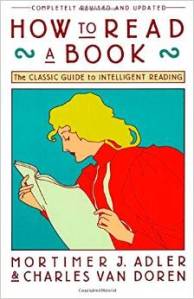 exercise you read a book?
Await at the comprehend, probably glance at the blurb; run your eye down the table of contents, perhaps; possibly burglarize through the book… then plunge right in into Chapter One.
Right?
Wrong! According to Mortimer J. Adler and Charles Van Doren, the authors of How to Read a Book.
According to them, this is only the starting time level of reading, called "Elementary" reading: and this is the only level the majority of readers in this globe accept reached. They posit three more levels: "Inspectional", "Analytical" and "Syntopic", each 1 more avant-garde than the previous. The major portion of the volume is devoted to analytic reading, followed by brief exposition on the syntopic. Information technology is the aim of the authors to make each reader of this tome into an analytic reader at least, if not a syntopic ane: it is my opinion that they simply succeed partially, but allow's become into that after analysing each of the levels as defined by the authors.
Uncomplicated reading nosotros accept already seen. In inspectional reading, yous first skim the book as a whole; give it a "in one case-over", equally it is. The authors, ever practical, suggest six steps to do this – nearly of them self-evident and what any serious reader unremarkably does with an expository book (this book is mostly nearly reading expository material and of limited value in reading literature and poesy, simply more about that later). The steps are:
1. Read the title and the preface
2. Report the tabular array of contents
3. Cheque the index
4. Read the blurb
5. Wait at the chief chapters
6. Skim the book, reading it here and there
Next, read the book through fast, without getting stuck at the difficult places. If the book deserves our serious attention, we tin can come back to those difficult places in our next reading. The advantage of this "rapid-fire" approach is that nosotros do not waste time on a book which deserves only a superficial reading. In the authors' own words: "Every book should exist read no more than slowly than it deserves, and no more than chop-chop than you tin read information technology with satisfaction and comprehension."
Analytical Reading
The side by side level, analytical reading, requires the reader to be demanding: the more you demand, the more you can extract out of a book. To do this, ane has to enquire 4 questions:
1. What is the volume about, as a whole?
2. What is being said in detail, and how?
iii. Is the book true, in whole or part?
iv. What of it?
How enquire these four questions is explained in detail, in the remaining part of the volume.
Analytical reading has iii stages. The first ane is mainly concerned with classifying the book, and understanding its aim and structure. To do this, the authors suggest four rules.
1. You must know what kind of book y'all are reading, and you should know equally early in the process as possible, preferably before you begin to read.
2. State the unity of the whole book in a unmarried sentence, or at virtually a few sentences (a short paragraph).
iii. Set along the major parts of the volume, and bear witness how these are organised into a whole, by being ordered to one another and to the unity of the whole.
4. Find out what the author'due south problems were.
The first rule classifies ("pigeonholes") the book, by affixing it to a category, genre, etc.: the 2nd is used to create a précis: the third expands the précis into an outline, thus revealing the underlying construction ("Ten-Raying" the volume, as the authors name it) and the fourth defines the purpose of the book. The author presumably wrote information technology for a reason: he had some questions at the start, which he has presumably tried to answer through the volume. The reader has to find out what these questions are.
If the first phase of analytical reading is related to the what , the second is related to the how ; how has the author attempted to solve the trouble with which he started out. For this phase also, Adler and Van Doren proposes 4 rules.
ane. Come to terms with the author by interpreting his key words.
2. Grasp the writer's leading propositions by dealing with his virtually of import sentences.
three. Know the author's arguments past finding them in, or constructing them out of, sequences of sentences.
4. Determine which of his bug the author has solved, and which he has not: and as to the latter, decide which the author knew he had failed to solve.
The argument here that whatsoever author, putting forth an statement, will use certain key words and terms (for case "natural option" and "evolution" by Darwin in The Origin of Species). It is the reader's duty to come to terms with the writer, so that he does not misinterpret the author'due south intentions by misreading the terms. Then on, it is an practise in logic by understanding the propositions and arguments. This is not equally hard as it looks: in fact, we do it all the time, even though the exact logical terms may be unfamiliar to united states of america. A proposition is cypher but the meaning contained inside a declarative sentence: and arguments what the author uses to prove the truth of the proffer.
The 4th step is a little more difficult for the lay reader, and it volition only come up through practice. Ane needs to notice out which of the issues presented the author had been able to solve: and if he had been unable to solve some, whether he knew he had failed or not. At this point of fourth dimension, information technology is non important whether the reader agrees with the author. That comes afterwards. Here, we are talking about the author's own internal logic, and how far he has been able to nowadays his arguments consistently in light of information technology, and how far he has been in successfully last his arguments.
In the third phase of analytical reading, the reader, for the first time, starts to utilize his disquisitional senses and begins to agree or disagree with the writer. Here according to the authors of the current book, the reader has to follow certain etiquette, captured in the following three rules:
ane. Do not begin criticism until one has completed the outline (showtime phase) and interpretation (second stage). And so one can concur, disagree or suspend judgement.
2. Do not disagree disputatiously or contentiously. Or in plain words, unless one can nowadays factual evidence acceptable at least to oneself, disagreement with an author based on emotional prejudice should be avoided (easier said than done!).
3. Demonstrate that i knows the difference between cognition and mere personal stance by presenting skillful reasons for any critical judgement one makes.
The authors also provide special criteria for criticism: (1) show where the author is uninformed, (2) show where he is misinformed, (iii) show where his illogical and (4) show where his analysis is incomplete.
Syntopic Reading
This is the fourth (and well-nigh advanced) level of reading, according to Adler and Van Doren – though I'd mayhap disagree. Here, the reader is engaged in researching books well-nigh ane basic thought. For example, if yous want to read up on, say evolution, yous must first understand what the significant books are on the subject area: and then y'all must proceed to read them, and summarise the arguments, both pro and con, preferably remaining objective throughout. Phew! Non a very easy task.
Don't worry, the authors requite step-by-stride instructions for this level also. Outset, create a bibliography of the subject and inspect all of the books to ascertain which are the relevant ones: then, do the following:
1. Do inspectional reading of the selected volume to choose the passages which are most relevant to the subject at mitt;
2. Establish a neutral terminology which is applicable to all the authors, so that all of them tin exist brought to the same terms;
three. Establish a set of neutral propositions, by framing a fix of questions which all the authors can be seen as answering;
4. Range the answers on both sides of the issue. The upshot may not always explicitly exist, and may accept to exist constructed past interpretation of the authors' views (for example, in the case of evolutionary theory, "Intelligent Design" is a form of creationism even though the trappings of evolutionary theory are used);
5. Analyse the discussion by ordering the issues to throw maximum calorie-free on the subject.
The authors stress the need for dialectical objectivity throughout; that is, the reader is only expected to conform and present the arguments so equally to nowadays an ordered discussion without taking sides. So the aim of syntopical reading is to "articulate abroad the deadwood and prepare the way for an original thinker to make a breakthrough".
***
Whoever has read through this review and so far would be request (him/her)self: "But that's applicable to expository books, where the main aim is the dissemination of data? What about fiction? What nearly poetry? What nearly drama?" Well, the authors extend their methodology to all kinds of books, merely co-ordinate to me, information technology falls flat. All said and washed, the methodology works only for expository works. And that is its main problem.
This book is not about literary theory or criticism: nor is it near literature appreciation. It is a self-help volume on the lines of those on time management, attending interviews, etc. It outlines a methodology, the diligent following of which will guarantee results, according to its authors. Information technology well may, for the major function of the book devoted to analytical reading gave me some insights on how to tackle books on hard subjects like philosophy and political theory (the two stars are for that). But the book is extremely irksome, and the authors' insistence on applying their favourite methodology to all sorts of books was stretching things a flake (moreover, it takes all the fun out of reading!). And syntopic reading may make sense to an undergraduate preparing a dissertation, just is of trivial use to anybody else.
If anyone wants to read this book, I would recommend an inspectional reading concentrating mainly on the methodology of belittling reading only. The other parts are not worth the fourth dimension spent on it.
I purchased a copy, but the book seems to be available gratuitous on the net (no idea most copyright issues!), so go ahead and try it if you want. Statutory alarm: colorlessness alee.
Source: https://nandakishorevarma.wordpress.com/2015/04/25/a-review-of-how-to-read-a-book-by-mortimer-j-adler-and-charles-van-doren/
0 Response to "How to Read a Book by Mortimer Adler and Charles Van Doren"
Post a Comment