What Concentration Camp Did Anne Frank's Family Go to
| Otto Frank | |
|---|---|
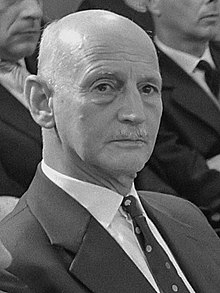 Frank in 1961 | |
| Born | Otto Heinrich Frank (1889-05-12)12 May 1889 Frankfurt am Main, Province of Hesse-Nassau, |
| Died | 19 August 1980(1980-08-19) (aged 91) Birsfelden, Basel-Landschaft, Switzerland |
| Resting place | Birsfelden'south Cemetery |
| Nationality | German,(rev) Swiss, Dutch |
| Occupation | Spice merchant[1] |
| Known for | Male parent of Anne Frank; The Diary of a Young Girl |
| Spouse(due south) | Edith Holländer (one thousand. 1925; died 1945) Elfriede Geiringer (one thousand. 1953) |
| Children | Margot Frank and Anne Frank |
| Military career | |
| Allegiance |  German Empire German Empire |
| Service/ | Imperial German Army |
| Years of service | 1915–1918 |
| Rank | Lieutenant |
| Battles/wars | World State of war I |
Otto Heinrich Frank (12 May 1889 – 19 August 1980) was a German language businessman who later became a resident of holland and Switzerland. He was the father of Anne and Margot Frank and husband of Edith Frank, and was the sole fellow member of his family to survive the Holocaust. He inherited Anne's manuscripts after her death, arranged for the publication of her diary as The Diary of a Young Girl in 1947, and oversaw its accommodation to both theater and flick.
Early life [edit]
Otto Frank was built-in into a liberal Jewish family unit.[ii] He was the second of 4 children born to Alice Betty (née Stern, 1865–1953) and Michael Frank (1851–1909).[three] His elder brother was Robert Frank, and younger siblings were Herbert Frank and Helene (Leni) Frank.[iv] Otto was a cousin of the article of furniture designer Jean-Michel Frank and a grandson of Zacharias Frank. His father originally came from the town of Landau, and moved to Frankfurt in 1879, marrying Alice Stern in 1886. Alice and Michael Frank placed value on a centre-class education. Otto had music lessons, learned to ride a horse and visited the theatre and opera regularly. The Frank family enjoyed a big circle of friends, and kept a welcoming home.[2] Otto studied economics in Heidelberg from 1908 to 1909 and had a work feel placement at Macy'due south Department Shop in New York City thanks to a college friend his age, Nathan Straus Jr. Yet, after leaving for New York, he had to return home briefly after his male parent died in September 1909, before once more leaving for the United States, returning to Germany two years subsequently in 1911.[5]
Globe State of war I [edit]
Frank served in the Imperial German Army during the First World War. He and his two brothers were called upwardly for armed forces service in August 1915 and later on preparation at a depot in Mainz, he served in an arms unit on the Western Forepart in which most soldiers were mathematicians and surveyors. He was attached to the infantry as a range-finder at the Battle of the Somme in 1916. In 1917, he was promoted in the field to lieutenant and served at the Battle of Cambrai just two of his French cousins, Oscar and Georges, were killed in action. According to other sources, Otto was late returning abode considering he was ordered to confiscate two horses from a farmer and returned them to the farmer when the state of war ended in defeat.[5] [6]
Matrimony and children [edit]
Frank worked in the bank that his father initially ran, which subsequently he and his brothers took over until its collapse in the early 1930s. He married Edith Holländer – an heiress to a flake-metallic and industrial-supply business concern – on his 36th birthday, 12 May 1925, at the synagogue in Aachen, Edith's home town. Edith was 25 when they married. Their elder daughter, Margot Frank (Margot Betti), was born 16 February 1926, followed by their younger girl, Anne (Annelies Marie), on 12 June 1929.[seven] Edith died of starvation and disease in Auschwitz on 6 Jan 1945. In late October 1944, Margot and Anne were transferred from Auschwitz to the Bergen-Belsen concentration camp where they died[8] of typhus.
In 1953, Frank married Elfriede Geiringer, a Holocaust survivor, who assisted him with the Anne Frank Foundation in Basel,[ix] which he launched a decade later on. Geiringer's daughter, Eva Schloss, is a Holocaust survivor, peace activist and international speaker.[10]
Globe State of war II [edit]
Equally the tide of Nazism rose in Germany and anti-Jewish decrees encouraged attacks on Jewish individuals and families, Otto decided to evacuate his family. In August 1933, they relocated to Aachen, where his mother-in-police resided, in preparation for a subsequent and final move to Amsterdam in the Netherlands. In the same yr, Otto's widowed female parent Alice fled to Switzerland.[11]
Otto'due south brother-in-police Erich Elias (husband of his younger sister Leni and father of Buddy Elias) worked in Basel for Opekta, a company that sold spices and pectin for employ in the industry of jam. Originating in Germany, the company was looking to aggrandize its operations in Europe, and Erich bundled for Otto to work as Opekta's agent in Amsterdam, allowing Otto to have an income to back up his family unit. Otto and his family lived in Merwedeplein in the mod suburb of Amsterdam-Zuid; they came to know many other German emigrant families. In 1938, Otto Frank started a second company, Pectacon, which was a wholesaler of herbs, pickling salts, and mixed spices, used in the production of sausages.[12] [thirteen] Hermann van Pels was employed by Pectacon as an advisor near spices. A Jewish butcher, he had fled Osnabrück with his family unit.[xiii] In 1939, Edith Frank'due south female parent came to live with the Franks and remained with them until her death in January 1942.[14] After Germany invaded the Netherlands in May 1940, Otto Frank was forced past the Germans to give up his companies. Otto made his businesses await "Aryan" by transferring control to his employees.[15]
In 1938 and 1941, Frank attempted to obtain visas for his family to emigrate to the United States or Cuba. He was granted a single visa for himself to Republic of cuba on 1 December 1941, merely it is not known if it ever reached him. Ten days afterward, when Nazi Germany and Fascist Italy declared state of war on the United States, the visa was cancelled.[16] [17]
At the age of 53, when the systematic displacement of Jews from holland started in the summer of 1942, Otto Frank took his family into hiding on 6 July 1942 in the upper rear rooms of the Opekta premises on the Prinsengracht, backside a concealing bookcase. The day earlier his older daughter, Margot, had received the written summons to report for and so-called labour duty in Germany, and Otto immediately decided to move the family to safety. They were joined a week after past Hermann van Pels, who was known as Herman van Daan in Anne'due south diary, his wife, Auguste van Pels and their son, Peter van Pels. In November, the group was joined by Fritz Pfeffer, known in Anne'due south diary as Albert Dussel. Their darkening was aided by Otto Frank's colleagues Johannes Kleiman, whom he had known since 1923, Miep Gies, Victor Kugler, and Bep Voskuijl.[xviii]
The group hid for two years, until their discovery in August 1944. It is not known if an informant, or adventure discovery by authorities, ended their catamenia of refuge.[xix] [xx] The group, along with Kugler and Kleiman, were arrested by SS Officer Karl Silberbauer. Later on beingness imprisoned in Amsterdam, the Jewish prisoners were sent to the Dutch transit camp of Westerbork and finally to Auschwitz Birkenau, where in September Frank was separated from his married woman and daughters. He was sent to the men's billet and was residing in the sick barracks when the camp was liberated by Soviet troops on 27 January 1945. Afterwards the liberation of Auschwitz, Otto Frank wrote to his mother in Switzerland, where she had fled in 1933 when Hitler came to power.[3] [21] He traveled dorsum to the Netherlands over the next 6 months and searched diligently for his family and friends. Past the end of 1945, he realized he was the sole survivor of those who had hidden in the business firm on the Prinsengracht.[22]
Letter from the Monowai steamship [edit]
The closer we become to home the greater our impatience to hear from our loved ones. Everything that'due south happened the past few years! Until our arrest I don't know exactly what caused it, even now, at least nosotros still had contact with each other. I don't know what'due south happened since and so. Kugler and Kleiman and particularly Miep and her married man and Bep Voskuil provided united states with everything for 2 whole years, with unequalled devotion and cede and despite all danger. I can't even begin to describe information technology. How will I ever begin to repay everything they did. Merely what has happened since then? To them, to yous to Robert [Otto'south brother]. Are you in touch with Julius and Walter? [Edith Frank's brothers] All our possessions are gone. There won't be a pin left, the Germans stole everything. Not a photograph, letter of the alphabet or document remains. Financially we were fine in the past few years, I earned good money and saved it. Now it'southward all gone. Just I don't recollect near whatever of that. Nosotros have lived through too much to worry about that kind of affair. Only the children thing, the children. I hope to get news from y'all immediately. Maybe y'all've already heard news about the girls.[23]
—Letter sent by Otto Frank on lath the Monowai steamship xv May 1945 on his way dorsum to Amsterdam
Mail service-state of war life [edit]
Subsequently Anne Frank'south death was confirmed in the summer of 1945, her diary and papers were given to Otto Frank by Miep Gies, who rescued them from the ransacked hiding place. As Miep Gies wrote in her volume, "Anne Frank Remembered," Mr. Frank immediately started to read the papers. Later he began transcribing them for his relatives in Switzerland. He was persuaded that Anne's writing shed light on the experiences of those who suffered persecution nether the Nazis and was urged to consider publishing it. He typed out the diary into a unmarried manuscript, editing out sections he idea as well personal to his family or as well mundane to be of involvement to the general reader. The manuscript was read past Dutch historian January Romein, who reviewed it on iii April 1946 for the Het Parool paper. This attracted the interest of Amsterdam'due south Contact Publishing, which accepted it for publication in the summer of 1946. Otto Frank is now recognized every bit a co-author of the diary.[24]
On 25 June 1947, the kickoff Dutch edition of the diary was issued under the title Het Achterhuis ("The Hole-and-corner Addendum"). Its success led to an English translation in 1952, which led to a theatrical dramatisation and somewhen the film The Diary of Anne Frank (1959), with actor Joseph Schildkraut as Otto.[25]

Otto Frank Inaugurated the Statue of Anne Frank, Amsterdam 1977.
Otto Frank married former Amsterdam neighbor and fellow Auschwitz survivor[26] Elfriede Geiringer (1905–1998) in Amsterdam on 10 November 1953, and the couple moved to Basel, Switzerland, where he had family, including relatives' children, with whom he shared his experiences. In 1963, he founded in Basel the Anne Frank Foundation (not to be dislocated with the Anne Frank Foundation in Amsterdam, see beneath), which is devoted to global distribution and utilise of the Diary of Anne Frank. The non profit organisation uses the proceeds of the copyrights for charitable purposes, education, and scientific research. In addition the Foundation in Basel supports projects in the field of human rights, racism and rights and promoting social justice.[27]
In response to a sabotage club placed on the building in which Otto Frank and his family hid during the war, he and Johannes Kleiman helped establish the Anne Frank Foundation in Amsterdam on 3 May 1957, with the principal aim to relieve and restore the edifice then it could be opened to the general public. With the aid of public donations, the building and the adjacent one were purchased past the Amsterdam-based foundation. It opened as a museum (the Anne Frank House) on 3 May 1960 and is however in functioning.[28]
The residuum of his life Otto Frank dedicated himself to the publication of the diary and the ethics his daughter had expressed in it.[29] Otto Frank died of lung cancer on 19 August 1980 in Birsfelden and his ashes were buried in the boondocks'due south cemetery, where Elfriede would also be cached, in the same tomb, eighteen years later.[thirty] He was survived by his stepdaughter Eva Schloss,[31] his sis Helene Frank and her 2 children.[32]
Otto Frank designated the Anne Frank Foundation in Basel equally his sole heir and legal successor, which means that the copyrights of all Anne Frank's writings belong to this organisation.[33]
Legal fights against Nazi sympathizers [edit]
In the years after the diaries were published, Otto Frank became embroiled in a series of legal battles with individuals who accused him or others of forging the manuscript; these cases would persist even after Frank's death in 1980. In 1959, Frank "lodged a criminal complaint on the grounds of libel, slander, defamation, maligning the memory of a deceased person and antisemitic utterances"[34] against two members of the right-wing Deutsche Reichspartei, Lothar Stielau and Heinrich Buddeberg, who had dismissed the diary every bit a work of fiction.
In 1976, Nazi sympathizer Ernst Römer defendant Frank of editing and fabricating parts of Anne'south diary. Frank filed a lawsuit confronting him. As with the previous case, the courtroom determined that the diary was authentic. Römer ordered a second investigation, but this time involving Hamburg'due south Bundeskriminalamt (BKA). It was claimed that parts of her diary were written with ballpoint pen ink, which did non exist prior to 1951. Yet, these parts were merely two scraps of paper not fastened to the manuscript, and conspicuously written in unlike handwriting, and some page numbers, presumed to accept been added by Otto Frank when compiling the diary for publication.[35] Reporters were unable to question Frank, every bit he died around the time of the discovery.[36]
References [edit]
- ^ Carol Ann Lee, The Hidden Life of Otto Frank (Harper Collins, 2003)
- ^ a b Anne Frank Fonds/Otto Frank
- ^ a b "Photo Gallery: Treasures of the Anne Frank Family unit". Der Spiegel. Hamburg, Germany.
- ^ "Photo Gallery: Treasures of the Anne Frank Family". Der Spiegel. Hamburg, Germany.
- ^ a b Otto Frank at Anne Frank Guide. Retrieved 29 May 2014
- ^ Lee, Ballad Ann (2000). The Biography of Anne Frank – Roses from the Earth. London: Viking Press. ISBN978-0-7089-9174-ix.
- ^ Carol Ann Lee, The Hidden Life of Otto Frank (Harper Collins, 2003), pp. 8–ix
- ^ "Anne Frank". Anne Frank Firm. 25 September 2018. Retrieved 29 July 2021.
{{cite web}}: CS1 maint: url-condition (link) - ^ "History of the foundation". Anne Frank Fonds . Retrieved 25 August 2021.
{{cite web}}: CS1 maint: url-status (link) - ^ "A Celebrated Evening With Anne Frank's Stepsister Eva Schloss". Northrop. 27 October 2019. Retrieved 29 July 2021.
{{cite web}}: CS1 maint: url-status (link) - ^ Verhoeven, Rian (1993). Anne Frank beyond the Diary. New York: Puffin/Penguin. p. 19. ISBN9780590474474.
- ^ Müller 1999, p. 92. sfn fault: no target: CITEREFMüller1999 (help)
- ^ a b Lee 2000, p. 40.
- ^ Müller 1999, pp. 128–130. sfn mistake: no target: CITEREFMüller1999 (help)
- ^ "Otto Frank". Anne Frank House. 29 July 2021. Retrieved 29 July 2021.
{{cite web}}: CS1 maint: url-status (link) - ^ "Anne Frank family letters released". CNN.com. fourteen Feb 2007. Archived from the original on 16 Feb 2007. Retrieved 14 Feb 2007.
- ^ Patricia Cohen (15 Feb 2007). "In Old Files, Fading Hopes of Anne Frank's Family". The New York Times . Retrieved xv February 2007.
In order to attain a neutral country, Frank then tried to obtain a Cuban visa, a risky, expensive and oft corrupt process. In a Sep. 8 letter to Straus, he wrote, "I know that it will be impossible for us all to leave even if most of the coin is refundable, merely Edith urges me to leave lone or with the children." On Oct. 12, 1941, he wrote, "Information technology is all much more than difficult equally i can imagine and is getting more than complicated every day." Because of the doubtfulness, he decided offset to try for a unmarried visa for himself. It is granted and forwarded to Otto Frank on Dec. ane. No ane knows if information technology e'er arrived; 10 days later, Federal republic of germany and Italia declared war on the United States, and Havana cancelled the visa.
- ^ "The people living in the Cloak-and-dagger Annex". Anne Frank House. 25 September 2018. Retrieved 29 July 2021.
{{cite spider web}}: CS1 maint: url-status (link) - ^ Patricia Cohen (17 Dec 2016). "Anne Frank's arrest might not have stemmed from expose". CNN.com. Retrieved 17 December 2016.
Perchance the Sicherheitsdienst or SD (German Security Service) didn't come to hunt for Jews that day, but inadvertently found the two families in hiding while investigating another matter.
- ^ "New Study Casts Doubt on Theory Anne Frank Was Betrayed". NBC News. Associated Printing. 17 December 2016. Retrieved 18 Dec 2016.
- ^ "Photo Gallery: Treasures of the Anne Frank Family". Der Spiegel. Hamburg, Germany.
- ^ Von Benda-Beckmann, Bas (2020). Na het Achterhuis. Anne Frank en de andere onderduikers in de kampen. Amsterdam: Querido. p. 310. ISBN9789021423937.
- ^ Treasures From The Attic Folio 202
- ^ Carvajal, Doreen (13 Nov 2015). "Anne Frank's Diary Gains 'Co-Author' in Copyright Move". The New York Times.
- ^ "How did Anne's diary become and so famous?". Anne Frank House. 15 October 2018. Retrieved 29 July 2021.
{{cite web}}: CS1 maint: url-condition (link) - ^ Goldsmith, Belinda (8 April 2013). "Anne Frank's step-sister highlights post-Holocaust traumas". Reuters . Retrieved 13 April 2013.
- ^ "Anne Frank Fonds/work". Anne Frank Fonds . Retrieved 29 July 2021.
{{cite spider web}}: CS1 maint: url-status (link) - ^ "Anne Frank Firm celebrates 60th anniversary". Anne Frank House. 30 April 2020. Retrieved 29 July 2021.
{{cite web}}: CS1 maint: url-status (link) - ^ "Otto Frank". Anne Frank Fonds . Retrieved 11 August 2021.
{{cite web}}: CS1 maint: url-status (link) - ^ "Otto Frank, Father of Anne, Dead at 91. Daughter'due south Famed Diary Described Life in Hiding From the Nazis. Family unit Died in Camps". The New York Times. United Press International. 21 August 1980. Retrieved 4 November 2010.
Otto Frank, whose teen-historic period girl Anne described two years of hiding from the Nazis in a diary that became world-renowned, died in a hospital here last night. He was 91 years old.
- ^ Duerden, Nick (6 April 2013). "I've been haunted by Anne Frank's memory for so long". The Guardian . Retrieved half dozen Apr 2013.
- ^ Butnick, Stephanie (23 March 2015). "Anne Frank's Last Living Relative Dies at 89". Tabletmag . Retrieved 23 March 2015.
- ^ "History of the foundation". Anne Frank Fonds . Retrieved 26 August 2021.
{{cite spider web}}: CS1 maint: url-status (link) - ^ "The actuality of the diary of Anne Frank". Anne Frank House. Retrieved 14 Jan 2022.
- ^ "Anne Frank Business firm Ballpoint Pen". Anne Frank House. Retrieved 17 July 2021.
- ^ "Blaue paste" [Blue paste]. Der Spiegel. 5 October 1980. Retrieved 9 July 2021.
Books [edit]
- The Diary of a Immature Girl, Anne Frank ISBN 0-553-29698-1
- Anne Frank Remembered, Miep Gies and Alison Leslie Gold ISBN 0-671-66234-1
- Anne Frank: The Untold Story. The hidden truth about Elli Vossen, the youngest helper of the Secret Annex, Jeroen De Bruyn and Joop van Wijk ISBN 9789082901306
- The Hidden Life of Otto Frank, Ballad Ann Lee ISBN 0-670-91331-6
- Roses from the Earth: the biography of Anne Frank, Carol Ann Lee ISBN 0-670-88140-vi
- Love, Otto, Cara Wilson ISBN 0-8362-7032-0
- Eva'due south Story, Eva Schloss ISBN 0-9523716-9-three
- Mirjam Pressler, Treasures From The Attic ISBN 1407231103
Films [edit]
Otto Frank was played past British actor, Ben Kingsley in the 2001 miniseries Anne Frank: The Whole Story.
Otto was portrayed by Italian role player, Emilio Solfrizzi in the Tv set picture Memories of Anne Frank.
External links [edit]
 | Wikimedia Commons has media related to Otto Frank. |
- Profile of Otto Frank's early life, written by the Anne Frank House
- BBC video interview with Otto Frank in 1976 (requires RealPlayer)
- Brusk article about Otto Frank's concluding years, with a photo taken in 1979
- Feature documentary about Otto'due south recently discovered letters, which reveal the plight of his family to find refuge from the Nazis in the US and elsewhere
- BBC video interview with Otto Frank in 1976 (requires RealPlayer)
- Otto Frank and Miep Gies in a video from the opening yr of the Anne Frank Business firm in 1960 (English subtitles)
- Oral testimony of Otto Frank, US Holocaust Museum
- Website Anne Frank Foundation Basel
Source: https://en.wikipedia.org/wiki/Otto_Frank
0 Response to "What Concentration Camp Did Anne Frank's Family Go to"
Post a Comment