Clans From Africa Agains Clans From Japan
| " | On the edge of Eastern asia, an industrious and vibrant culture built on a strict organisation of award and personal virtue blossomed and enthralled contemporary and modern observers alike. Brilliant tacticians led courageous and skilled infantry forces to stunning victories while ascetic monks fostered intellectual growth. The fearsome leaders of your armies are the Samurai, whose sharp blades tin can cutting down fifty-fifty the strongest and proudest among the enemy forces! | " |
| —Description[i] | ||
The Japanese' civilization music theme in the Definitive Edition
The Japanese are an Eastward Asian civilization in Age of Empires II. They are an infantry-based civilization, with their infantry possessing the fastest attack speed in the game. They are the descendants of the Yamato culture, which inhabited the same island. The Japanese civilization is based on Feudal Japan which was dominated by the powerful regional families (daimyō) and the military rule of warlords (shōgun) from 1185 to 1868.
Despite the Japanese infantry focus and selection for an infantry rush, the Japanese have unlike options in their tech tree, equally they are ane of the 2 culture to have all important upgrades for their Archery Range units, accept a about-complete Monastery tech tree, and even serviceable Castle Historic period cavalry, despite missing several key Regal Age upgrades. This makes the Japanese an appealing civilization for players who can transition to other units later on their initial infantry rush in the Dark Age or Feudal Age. Their simplistic and straightforward bonuses for their Line-fishing Ships and Galleys (combined with their cheaper Mills, Lumber Camps, and Mining Camps) also makes them a beginner-friendly civilization to learn how to play in h2o maps.
The Japanese also announced in Age of Empires III: The Asian Dynasties equally a playable civilization, which covers the Japanese from the late Sengoku period to the Meiji Restoration catamenia.
Overview [ ]
The Japanese are an infantry civilization and command the strongest infantry of all civilizations with all technologies and upgrades available plus a speed heave for their attacks which results in a very loftier harm output. The Japanese also have superb archers (including Cavalry Archers) which they can too fully upgrade. Only their cavalry is weak and their siege weapons are underwhelming likewise but their Trebuchets profoundly benefit from Kataparuto meaning their sieging is even so fairly effective. Their navy is first-class, only defective the Heavy Sabotage Ship, simply with longer-sighted Galleons and all other improvements at their disposal. Their Monks are very practiced every bit well, only defective Heresy. Their defensive structures and economy are below average, withal.
Campaign appearances [ ]
The Japanese accept scenarios devoted to their civilization: Kyoto from the Battles of the Conquerors campaign and Kurikara from Battles of the Forgotten. They also appear as the enemy in the Noryang Signal scenario from Battles of the Conquerors.
Battles of the Conquerors [ ]
The Kyoto scenario is played as the Japanese.
- Kyoto
- Osaka - Enemy
- Kyoto - Enemy
- Nobunaga - Ally
- Hyogo - Enemy
- Noryang Point
- Japanese Navy - Enemy
- Japanese Raiders - Enemy
Battles of the Forgotten [ ]
This battle is played every bit the Japanese.
- Kurikara
- Hojo Clan - Ally
- Yoshinaka - Ally
- Locals - Ally
- Taira Warlords - Enemy
- Taira Guards - Enemy
- Taira Army - Enemy
- Kyoto - Enemy
Characteristics [ ]
Unique unit [ ]
-
 Samurai : Fast-attacking infantry with an attack bonus against unique units.
Unique technologies [ ]
-
 Yasama : Gives towers extra arrows.
 -
 Kataparuto : Makes Trebuchets pack, unpack, and fire faster.
Civilization bonuses [ ]
- Line-fishing Ships have double HP, +2 pierce armor, and work v%/10%/15%/20% faster in the Night/Feudal/Castle/Imperial Age.
- Mills, Lumber Camps and Mining Camps are 50% cheaper.
- Infantry attack 33% faster starting in the Feudal Age.
Team bonus [ ]
- Galleys have a +50% longer Line of Sight.
Changelog [ ]
The Age of Kings [ ]
- Infantry set on 11%/18%/33% faster in the Feudal/Castle/Imperial Age
- Cannot inquiry Gold Shaft Mining.
- Cannot research Treadmill Crane.
- Samurai train in 16 seconds
- Samurai have 0 pierce armor, a Rate of Burn down of 2.0, and move at a speed of 0.9
- Samurai take an assault bonus of +5 (+6 for Elite) against Unique units.
- Non-Elite Samurai have 60 hit points and 8 set on.
- The Elite Samurai upgrade costs 950 food, 875 gold.
The Conquerors [ ]
- Infantry now assail 33% faster starting in the Feudal Age.
- Cannot enquiry Bloodlines.
- Kataparuto introduced.
- Samurai at present railroad train in 9 seconds.
- Samurai now have 1 pierce armor, a Rate of Fire of i.9, and motility at a speed of one.
- Samurai now have an set on bonus of +x (+12 for Elite) confronting unique units.
The Forgotten [ ]
- Bloodlines added to the technology tree.
- Gold Shaft Mining added to the technology tree.
- Yasama introduced. Information technology costs 300F/400W and gives Towers 3 additional arrows.
The African Kingdoms [ ]
- Yasama at present costs 300F/300W.
- With patch 4.8, Yasama at present gives Towers 2 additional arrows.
- With patch 4.viii, Treadmill Crane was added to the applied science tree.
Dawn of the Dukes [ ]
- With update 56005, non-Elite Samurai have lxx hit points and ten attack.
- With update 56005, the Elite Samurai upgrade costs 750 food, 650 gold.
In-game dialogue language [ ]
In-game, Japanese villagers and military units speak modernistic Japanese while Monks and King speak archaicized modern Japanese.
- Villager
- Female Select ane Hai? (はい?) - Yes?
- Male person Select 1 Nani? (何?) - What?
- Female person Select two Watashi? (私?) - Me?
- Male Select 2 Ore? 俺? - Me? (men's spoken language)
- Select iii Ii yo (いいよ) - Alright
- Female Select four Nani? (何?) - What?
- Male Select iv Nan da (何だ?) - What is it?
- Chore 1 Hai, hai (はい, はい) - Yes, yes
- Task 2 Hai (はい) - Yeah
- Chore 3 Ikimasu (行きます) - I become
- Task 4 Wakarimashita (分かりました) - Understood
- Build Tatemasu (建てます) - I build
- Chop Ki wo kirimasu (木を切ります) - I cut a tree
- Farm Tagayashimasu (耕します) - I cultivate
- Fish Sakana wo torimasu (魚を捕ります) - I catch fish
- Forage Shūkaku shimasu (収穫します) - I gather
- Chase Kari wo shimasu (狩りをします) - I hunt
- Mine Horimasu (掘ります) - I mine
- Repair Naoshimasu (直します) - I repair
- Female Set on Ike! (行け!) - Become! (not used)
- Male person Attack Yattsukero! (やっつけろ!) - Let's defeat them! (non used)
- Armed services
- Select 1 Ha! (はっ!) - Yes!
- Select 2 Gyoi ni (御意に) - As you like
- Select 3 Gomeirei wo (御命令を) - Give me orders
- Motion 1 Iza! (いざ!) - Prepare yourself!
- Motion 2 Ōse no tōri (仰せの通り) - As y'all say! (literally - "In accordance with your volition")
- Motion 3 Shōchi (承知) - I understand
- Assault ane Ike! (行け!) - Go!
- Attack 2 Ikusa ja! (戦じゃ!) - State of war!
- Attack iii Iza, Shōbu! (いざ、勝負!) - Now, to the battle!
- Assault four
- Attack five
- Monk
- Select 1 Nan jana? (何じゃな?) - What is it?
- Select ii Yō kana? (用かな?) - How can I be of use?
- Select 3 Nan naritō (何なりと) - As you wish
- Move 1 Shōchi (承知) - I understand
- Motion 2 Hai (はい) - Yes
- Move 3 Mairi mashō (参りましょう) - I'm coming
- Motility 4 Tadaima (只今) - At one time
- King
- Select 1 Nan ja? (何じゃ?) - What is it?
- Select two Nani yō ka? (何用か?) - What is this regarding?
- Select three Kurushu nai (苦しゅうない) - Don't hesitate
- Select 4 Nozomi wa? (望みは?) - What is your wish?
- Move 1 Umu (うむ) - Yea
- Motility 2 Yokarō (良かろう) - Very well
- Motility 3 Sō itasō (そう致そう) - I shall do and then
- Move 4 Mairō (参ろう) - I shall go/come
AI thespian names [ ]
When playing a random map game confronting the figurer, the player may encounter any of the following Japanese AI characters:
- Ashikaga Takauji (足利尊氏): A founder and first shogun of the Ashikaga shogunate. His rule began in 1338, beginning the Muromachi catamenia of Japan, and ended with his death in 1358.
- Date Masamune (伊達政宗): A regional strongman of Nippon's Azuchi–Momoyama period through early on Edō flow. He ruled the southern Mutsu in the Tohoku region.
- Fujiwarano Michinaga (藤原道長 ) (966 – Jan 3, 1028)
- Gamou Ujisato (蒲生氏郷): A Japanese daimyō of the Sengoku and Azuchi-Momoyama periods.
- Hojou Soun (北条早雲): A the first caput of the Tardily Hōjō clan, one of the major powers in Nippon'southward Sengoku menstruum. He is well known for starting a rebellion against Horikoshi Kubo, the local ruler of the Kantō region of the Ashikaga clan, in 1495.
- Hosokawa Katsumoto (細川勝元): A one of the Kanrei, the Deputies to the Shogun, during Nihon'southward Muromachi menstruum.
- Imagawa Yoshimoto (今川 義元) (1519 – June 12, 1560)
- Kusonoki Masashige (楠木正成): A 14th-century samurai who fought for Emperor Go-Daigo in the Genkō State of war.
- Minamotono Yoritomo (源 頼朝) (May nine, 1147 – February 9, 1199): The founder and the first shōgun of the Kamakura Shogunate of Japan. He ruled from 1192 until 1199. His Buddhist name was Ogosho Atsushi Dai Zenmon (武皇嘯厚大禅門).
- Minamotono Yoshitsune (源義経): A nobleman and military commander of the Minamoto clan of Japan in the late Heian and early on Kamakura periods.
- Mouri Motonari (毛利元就): A prominent daimyō in the western Chūgoku region of Japan during the Sengoku period of the 16th century. Famous for starting and winning the Battle of Itsukushima (1555) against the superpower, which was Oouchi at that fourth dimension.
- Nitta Yoshisada (新田 義貞): A head of the Nitta association in the early fourteenth century, and supported the Southern Court of Emperor Go-Daigo in the Nanboku-chō period.
- Oda Nobunaga (織田信長) (June 23, 1534 – June 21, 1582): A powerful daimyō of Nihon in the late 16th century who attempted to unify Nihon during the belatedly Sengoku menses. Nobunaga is regarded as one of 3 unifiers of Japan along with his retainers Toyotomi Hideyoshi and Tokugawa Ieyasu. During his later life, Nobunaga was widely known for most fell suppression of determined opponents, eliminating those who past principle refused to cooperate or yield to his demands. He was both a skilled ruler and keen man of affairs, economical reformer, strategizing at both the micro- and macroeconomic scales. He was killed when his servant Akechi Mitsuhide rebelled against him at Honnō-ji.
- Saito Dousan (斎藤道三): Also known as Saitō Toshimasa, was a Japanese samurai during the Sengoku period. He is famous for his cunning tactics and starting a rebellion and banishing his ain lord, Toki Yoriaki, subsequently which he became the ruler of the Mino Province.
- Sanada Yukimura (真田幸村): Actual name: Sanada Nobushige, was a Japanese samurai warrior of the Sengoku period. He was especially known every bit the leading general on the defending side of the Siege of Osaka.
- Tairano Kiyomori (平清盛): A military leader of the late Heian menses of Nippon. He established the first samurai-dominated authoritative government in the history of Nippon.
- Takeda Shingen (武田信玄): A pre-eminent daimyō in feudal Nippon with exceptional armed forces prestige in the late stage of the Sengoku period. Based on the Kai Province, he was famous for his 'invincible' Takeda cavalry squad, but accidentally died on his way to Kyoto in 1573. He is nicknamed Tiger of Kai (甲斐の虎) in Nihon.
- Tokugawa Ieyasu (徳川家康): A founder and first shogun of the Tokugawa shogunate of Nihon, which effectively ruled Japan from the Battle of Sekigahara in 1600 until the Meiji Restoration in 1868. He is the AI personality of the Japanese in Historic period of Empires 3: The Asian Dynasties every bit well 1 of the characters of the Japanese campaign.
- Uesugi Kenshin (上杉謙信): A daimyō born in Nagao Kagetora, he was one of the most powerful daimyōs of the Sengoku period and he ruled the Echigo Province. He was famed for his honorable conduct as he made numerous campaigns to restore order in the Kantō region. He died in the same province of esophageal cancer. He is nicknamed God of Military (軍神) or Dragon of Echigo (越後の龍) in Japan.
Trivia [ ]
- The Japanese civilization icon is based on kikumon, the emblem of the Japanese imperial family.
- The user interface paradigm in the Definitive Edition represents the icons of the Tokugawa, Toyotomi, and Oda clans, respectively.
- One of the Japanese AI player names, Tokugawa Ieyasu, appears as the AI personality and as one of the characters of the Japanese campaign in Age of Empires III: The Asian Dynasties.
- Aslope Saracens, the Japanese are the simply civilization with access to all Archery Range units and technologies (with the exception of Elephant Archers, which are regional units).
- Before The Forgotten was released, the Japanese were the only civilization that was able to research Parthian Tactics, but not Bloodlines.
- The Japanese are now the only Due east Asian civilization that have access to Redemption.
History [ ]
| " | Located 100 miles off the mainland of Asia, at its closest point, Japan was a country of mystery at the edge of civilisation. Isolated at kickoff by geography and subsequently by choice, the Japanese developed a distinctive civilization that drew very footling from the outside world. At the beginning of what were the Centre Ages in Europe, the avant-garde culture of Nippon was centered at the north end of the Inland Sea on the chief isle of Honshu. Across the Hakone Mountains to the due east lay the Kanto, an alluvial plain that was the unmarried largest rice-growing area on the islands. To the n and east of the Kanto was the frontier, beyond which lived aboriginal Japanese who had occupied the islands since Neolithic times. Some believe that past the fifth century Advertisement the Yamato court had become largely ceremonial. Contained clans, known as uji, held the existent power backside the throne. Clan leaders formed a sort of aristocracy and vied with each other for effective control of land and the throne. In 536 the Soga clan became predominant and produced the get-go great historical statesman, Prince Shotoku, who instituted reforms that laid the foundation of Japanese civilisation for generations to come. In 645, ability shifted from the Soga clan to the Fujiwara clan. The Fujiwara presided over about of the Heian period (794 to 1185). The new leadership imposed the Taika Reform of 645, which attempted to redistribute the rice-growing state, institute a tax on farm production, and split up the country into provinces. Too much of the country remained outside imperial influence and control, still. Real ability shifted to great families that rose to prominence in the rice-growing lands. Conflict among these families led to civil war and the rise of the warrior grade. Like to the experience of medieval western Europe, the breakdown of central dominance in Nihon, the rising of powerful local nobles, and conflict with barbarians at the borderland combined to create a culture dominated by a warrior elite. These warriors became known as Samurai, ("those who serve"), who were roughly equivalent to the European knight. A military authorities replaced the nobility as the power behind the throne at the end of the 12th century. The head of the military government was the Shogun. Samurai lived by a code of the warrior, something like the European lawmaking of chivalry. The foundation of the warrior code was loyalty to the lord. The warrior expected leadership and protection. In render he obeyed his lord'southward commands without question and stood ready to die on his lord's behalf. A Samurai placed great emphasis on his ancestry and strove to bear on family traditions. He behaved so as to earn praise. He was to be business firm and show no cowardice. Warriors went into battle expecting and looking to dice. It was felt that a warrior hoping to live would fight poorly. The Kamakura period (1185 to 1333) was named later a region of Japan dominated by a new ruling clan that took power after ceremonious war. The Mongols attempted to invade Nihon twice, in 1274 and 1281, simply were repulsed both times. A fortuitous storm acquired not bad loss to the second Mongol invasion fleet. | " |
| —[ane] | ||
Gallery [ ]
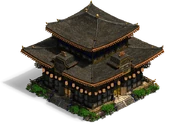
The Wonder of the Japanese, the Tōdai-ji
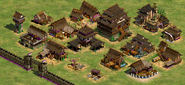

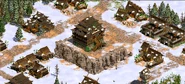
A Japanese town, as seen in Kyoto

Japanese user interface epitome
Video overview [ ]

References [ ]
- ↑ 1.0 1.1 https://www.forgottenempires.net/age-of-empires-two-definitive-edition/civilizations/japanese
| Civilizations in Age of Empires II | |
 The Age of Kings The Age of Kings | |
|---|---|
| East Asian | Chinese · Japanese · Mongols |
| Centre Eastern | Persians · Saracens · Turks |
| Central European | Goths · Teutons · Vikings |
| Western European | Britons · Celts · Franks |
| Mediterranean | Byzantines |
 The Conquerors The Conquerors | |
| Native American | Aztecs · Mayans |
| E Asian | Koreans |
| Central European | Huns |
| Mediterranean | Castilian |
 The Forgotten The Forgotten | |
| Native American | Incas |
| South Asian | Hindustanis (formerly Indians) |
| Eastern European | Magyars · Slavs |
| Mediterranean | Italians |
 The African Kingdoms The African Kingdoms | |
| African | Ethiopians · Malians |
| Middle Eastern | Berbers |
| Mediterranean | Portuguese |
 Rise of the Rajas Rise of the Rajas | |
| East Asian | Vietnamese |
| Southeast Asian | Burmese · Central khmer · Malay |
 The Last Khans (Definitive Edition) The Last Khans (Definitive Edition) | |
| Eastern European | Bulgarians · Lithuanians |
| Central Asian | Cumans · Tatars |
 Lords of the West Lords of the West | |
| Western European | Burgundians |
| Mediterranean | Sicilians |
 Dawn of the Dukes Dawn of the Dukes | |
| Eastern European | Bohemians · Poles |
 Dynasties of Republic of india Dynasties of Republic of india | |
| South Asian | Bengalis · Dravidians · Gurjaras |
Source: https://ageofempires.fandom.com/wiki/Japanese_%28Age_of_Empires_II%29
0 Response to "Clans From Africa Agains Clans From Japan"
Post a Comment