Which of These Is Not a Characteristic of Courtly African Art?


Near African sculpture was historically in wood and other organic materials that have not survived from earlier than at most a few centuries ago; older pottery figures are institute from a number of areas. Masks are important elements in the art of many peoples, along with human figures, often highly stylized. There is a vast variety of styles, often varying within the same context of origin depending on the use of the object, but wide regional trends are apparent; sculpture is near common among "groups of settled cultivators in the areas drained past the Niger and Congo rivers" in W Africa.[1] Direct images of African deities are relatively infrequent, but masks in particular are or were often fabricated for traditional African religious ceremonies; today many are made for tourists equally "airport art".[2] African masks were an influence on European Modernist art, which was inspired by their lack of concern for naturalistic depiction.
By region [edit]
The Nubian Kingdom of Kush in modern Sudan was in close and oft hostile contact with Egypt, and produced awe-inspiring sculpture mostly derivative of styles to the north. In West Africa, the earliest known sculptures are from the Nok culture which thrived between 500 BC and 500 AD in modernistic Nigeria, with clay figures typically with elongated bodies and athwart shapes.[3] Later West African cultures developed bronze casting for reliefs to decorate palaces similar the famous Republic of benin Bronzes, and very fine naturalistic royal heads from around the Yoruba town of Ife in terracotta and metal from the 12th to the 14th centuries. Akan goldweights are a form of pocket-size metal sculptures produced over the period 1400–1900, some apparently representing proverbs so with a narrative element rare in African sculpture, and royal regalia included impressive golden sculptured elements.[4]
Many West African figures are used in religious rituals and are ofttimes coated with materials placed on them for ceremonial offerings. The Mande-speaking peoples of the same region make pieces of wood with wide, flat surfaces and artillery and legs are shaped like cylinders. In Key Africa, however, the master distinguishing characteristics include heart-shaped faces that are curved inwards and brandish patterns of circles and dots.
Eastern Africans are not known for their sculpture,[5] but one way from the region is pole sculptures, carved in human shapes and busy with geometric forms, while the tops are carved with figures of animals, people, and various objects. These poles are then placed side by side to graves and are associated with death and the ancestral globe. The civilization known from Bully Zimbabwe left more impressive buildings than sculpture but the viii soapstone Zimbabwe Birds announced to have had a special significance and were mounted on monoliths. Modern Zimbabwean sculptors in soapstone take achieved considerable international success. Southern Africa's oldest known clay figures date from 400 to 600 AD and have cylindrical heads with a mixture of human and animal features.
-

Helmet mask (ndoli jowei) for Sande society; belatedly 19th-early 20th century; forest; 39.4 x 23.5 x 26 cm (fifteen one⁄2 x 9 1⁄iv x 10 1⁄4 in.); Brooklyn Museum (New York Metropolis). A vertical crack runs from base of mask to head band at back center and includes a triangular i 3⁄iv hole below band
-

Terra cotta seated effigy from Republic of mali; 13th century; earthenware; 29.9 cm (xi three⁄4 in) loftier; Metropolitan Museum of Fine art (New York City). The raised marks and indentations on the back of this hunched Djenné figure may stand for affliction or, more likely, sacrification patterns. The facial expression and pose could depict an individual in mouring or in pain
-

Chiwara headdress (male); late 19th-early on 20th century; 72.four x 30.5 x 7 cm (28 ane⁄ii x 12 x ii three⁄4 in.); past Bambara people; Brooklyn Museum. Chiwara masks are categorized in 3 ways: horizontal, vertical, or abstruse. In add-on, Chiwara can be either male or female
-

Poro mask; 19th-mid-20th century; wood, horns, raffia fiber, cotton cloth, feathers, metal; height: xxx ane⁄4 in.; past Senufo people; Metropolitan Museum of Art. Designed to pay homage to female ancestors, this mask's serene dark oval face is beginning by glinting brass, symmetrical extensions, and delicate patterns symbolizing wisdom and beauty
-

Kwele mask; 19th–20th century; forest coloured with kaolin; from Gabon or Democratic Democracy of Congo; tiptop: 52.7 cm (twenty 3⁄four in.), width: 38.one cm (15 in.); depth: 10.2 cm (4 in.); Metropolitan Museum of Art. This mask was used in the rituals of witchcraft protection
-
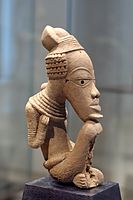
Nok seated effigy; 5th century BC – 5th century AD; terracotta; 38 cm (one ft 3 in); Musée du quai Branly (Paris). In this Nok work, the head is dramatically larger than the body supporting it, yet the figure possesses elegant details and a powerful focus. The neat protrusion from the mentum represents a beard. Necklaces from a cone around the neck and keep the focus on the confront
-
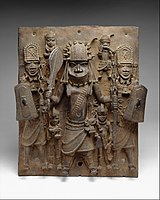
Benin plaque with warriors and attendants; 16th–17th century; brass; 47.6 cm (18 3⁄4 in.) height; Metropolitan Museum of Fine art. The Benin Bronzes led to a greater appreciation in Europe of African culture and art. Initially, it appeared incredible to the discoverers that people "supposedly so primitive and savage" were responsible for such highly developed objects[8]
-

Ndop of male monarch Mishe miShyaang maMbul; 1760–1780; woods; 49.five ten 19.four x 21.9 cm (19 1⁄two x 7 5⁄8 x 8 5⁄viii in.); Brooklyn Museum. Ndops are royal memorial portraits caverd by the Kuba people of Central Africa. They are non naturalistic portrayals simply are intended equally representations of the king's spirit and as an encapsulation of the principal of kingship
-

Ngady-Mwash mask; 19th century; from Kuba Kingdom; Ethnologic Museum of Berlin. A groovy deal of the art was created for the courts of chiefs and kings and was profusely decorated, incorporating cowrie shells and animal skins (especially leopard) as symbols of wealth, prestige and power
-
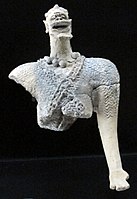
Sao anthropomorphic figure; ninth-16th century; from the n'djamena region; Musée du quai Branly
-
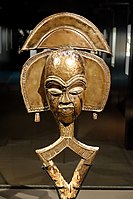
Mbulu viti reliquary figure; 19th-20th century; wood, brass, copper; by Kota people; Ethnographical Museum of Berlin. Finely carved and overlaid with contrasting cooper and contumely, this sculpture combines shimmering srfaces, minimal delineation of concrete features and torso, and an imaginative elaboration of the head
-

Ngil mask from Gabon or Republic of cameroon; wood colored with kaolin (chiny dirt); by Fang people; Ethnological Museum of Berlin. Worn with total costume in a night masquerade to settle disputes and quell misbehavior, this calm visage was terrifying to wrong-doers
-

Female person kifwebe mask; late 19th or early 20th century; 30.5 ten 18.1 x 15.6 cm (12 x 7 1⁄8 x 6 1⁄8 in.); Brooklyn Museum. The kifwebe masquerade is a genre shared by the Luba and Songye, indicative of the interaction that has occurred between the 2 societies. Kifwebe masks represent either male or female beings
-

Igbo maiden spirit helmet mask (Agbogho Mmwo); early on 20th century; fifty.2 x fourteen.6 x 30.5 cm (19 3⁄four x 5 3⁄four x 12 in.); Brooklyn Museum. This helmet mask has long narrow face, painted white; narrow protruding sharp nose; slit eyes; open mouth showing teeth; pocket-sized ears
-

Anthropomorphic trip the light fantastic mask; early on 19th century; by Adouma people; from Gabon; wood & pigments; Musée du quai Branly
-

-

Waga sculptures from Ethiopia
See also [edit]
- African art
- African traditional masks
- Tribal fine art
Notes [edit]
- ^ Honor & Fleming, 557
- ^ Honour & Fleming, 559–561
- ^ Breunig, P. 2015. Nok. African Sculpture in Archaeological Context. Africa Magna, Frankfurt a. M.
- ^ Honour & Fleming, 556–561
- ^ Honour & Fleming, 557
- ^ Smith, David. "British Museum may seek loan of the gold rhinoceros of Mapungubwe". The Guardian. Guardian News and Media Express. Retrieved 13 August 2016.
- ^ York, Geoffrey. "The render of the Golden Rhino". The Globe and Mail. The Globe and Mail Inc. Retrieved 13 Baronial 2016.
- ^ Meyerowitz, Eva 50. R. (1943). "Ancient Bronzes in the Royal Palace at Benin". The Burlington Magazine for Connoisseurs. The Burlington Magazine Publications, Ltd. 83 (487): 248–253. JSTOR 868735.
- ^ British Museum Highlights
- ^ British Museum Collection
- ^ "Earth Museum Website". Archived from the original on 2016-08-xviii. Retrieved 2018-09-29 .
- ^ Ethnological Museum Website Archived Feb 2, 2014, at the Wayback Machine
- ^ Picture of Lagos caput Archived Feb 2, 2014, at the Wayback Auto
References [edit]
- Hugh Honour and John Fleming, A Earth History of Art, 1st ed. 1982 (many afterward editions), Macmillan, London, page refs to 1984 Macmillan 1st ed. paperback. ISBN 0333371852
Farther reading [edit]
- Ezra, Kate (1988). Art of the Dogon: selections from the Lester Wunderman collection. New York: The Metropolitan Museum of Art. ISBN978-0870995071.
- LaGamma, Alisa (2003). Genesis: ideas of origin in African sculpture . New York: The Metropolitan Museum of Fine art. ISBN978-0300096873.
- Roese, Herbert Eastward (2011). African Wood Carvings, the sculptural fine art of West Africa. CARECK. ISBN978-0-9560294-2-three.
External links [edit]
- "African Votive Sculptures". Herbert Due east. Roese
- Sculpture of Nigeria and Republic of cameroon
Source: https://en.wikipedia.org/wiki/African_sculpture
0 Response to "Which of These Is Not a Characteristic of Courtly African Art?"
Post a Comment