Union Ships Blocking Detroit and Harbor Try Again Union Ships Blocking the Charleston Harbor
The Union occludent in the American Civil State of war was a naval strategy by the United states of america to prevent the Confederacy from trading.
The occludent was proclaimed by President Abraham Lincoln in Apr 1861, and required the monitoring of 3,500 miles (5,600 km) of Atlantic and Gulf coastline, including 12 major ports, notably New Orleans and Mobile. Those blockade runners fast enough to evade the Spousal relationship Navy could simply carry a small fraction of the supplies needed. They were operated largely past strange citizens, making use of neutral ports such as Havana, Nassau and Bermuda. The Union deputed around 500 ships, which destroyed or captured virtually one,500 blockade runners over the course of the war.
Annunciation of blockade and legal implications [edit]
On April 19, 1861, President Lincoln issued a Proclamation of Blockade Against Southern Ports:[one]
Whereas an insurrection against the Government of the United States has broken out in the States of South Carolina, Georgia, Alabama, Florida, Mississippi, Louisiana, and Texas, and the laws of the United States for the collection of the revenue cannot exist around executed therein comformably to that provision of the Constitution which requires duties to be compatible throughout the Usa:
And whereas a combination of persons engaged in such insurrection, have threatened to grant pretended letters of marque to authorize the bearers thereof to commit assaults on the lives, vessels, and property of good citizens of the state lawfully engaged in commerce on the high seas, and in waters of the United States: And whereas an Executive Proclamation has been already issued, requiring the persons engaged in these disorderly proceedings to desist therefrom, calling out a militia strength for the purpose of repressing the same, and convening Congress in extraordinary session, to deliberate and make up one's mind thereon:
Now, therefore, I, Abraham Lincoln, President of the United states of america, with a view to the same purposes earlier mentioned, and to the protection of the public peace, and the lives and property of quiet and orderly citizens pursuing their lawful occupations, until Congress shall have assembled and deliberated on the said unlawful proceedings, or until the aforementioned shall ceased, have further accounted information technology advisable to set on foot a blockade of the ports within us aforesaid, in pursuance of the laws of the United States, and of the law of Nations, in such example provided. For this purpose a competent force will be posted so as to prevent entrance and exit of vessels from the ports aforesaid. If, therefore, with a view to violate such blockade, a vessel shall approach, or shall attempt to leave either of the said ports, she will be duly warned by the Commander of one of the blockading vessels, who volition endorse on her annals the fact and date of such warning, and if the same vessel shall again effort to enter or leave the blockaded port, she will exist captured and sent to the nearest user-friendly port, for such proceedings against her and her cargo equally prize, as may exist deemed advisable.
And I hereby proclaim and declare that if any person, under the pretended authority of the said States, or nether whatever other pretense, shall molest a vessel of the The states, or the persons or cargo on lath of her, such person will be held acquiescent to the laws of the United States for the prevention and punishment of piracy.
In witness whereof, I have hereunto gear up my hand, and acquired the seal of the U.s.a. to be affixed.
Done at the City of Washington, this nineteenth 24-hour interval of April, in the year of our Lord thou 8 hundred and sixty-ane, and of the Independence of the United States the eighty-fifth.
Operations [edit]
Scope [edit]
A joint Marriage military-navy committee, known as the Blockade Strategy Lath, was formed to brand plans for seizing major Southern ports to utilize as Union bases of operations to expand the blockade. Information technology showtime met in June 1861 in Washington, D.C., nether the leadership of Captain Samuel F. Du Pont.[2]
In the initial phase of the blockade, Wedlock forces concentrated on the Atlantic Coast. The Nov 1861 capture of Port Royal in South Carolina provided the Federals with an open ocean port and repair and maintenance facilities in adept operating condition. It became an early base of operations of operations for further expansion of the blockade along the Atlantic coastline,[3] including the Stone Fleet of old ships deliberately sunk to cake approaches to Charleston, S Carolina. Apalachicola, Florida, received Confederate goods traveling down the Chattahoochee River from Columbus, Georgia, and was an early on target of Marriage blockade efforts on Florida'southward Gulf Declension.[iv] Some other early prize was Ship Island, which gave the Navy a base from which to patrol the entrances to both the Mississippi River and Mobile Bay. The Navy gradually extended its reach throughout the Gulf of Mexico to the Texas coastline, including Galveston and Sabine Pass.[5]
With iii,500 miles (5,600 km) of Confederate coastline and 180 possible ports of entry to patrol, the occludent would be the largest such effort ever attempted. The United States Navy had 42 ships in active service, and some other 48 laid up and listed equally available as soon as crews could be assembled and trained. Half were sailing ships, some were technologically outdated, most were at the time patrolling distant oceans, one served on Lake Erie and could non be moved into the body of water, and another had gone missing off Hawaii.[6] At the fourth dimension of the declaration of the blockade, the Union but had iii ships suitable for occludent duty. The Navy Section, under the leadership of Navy Secretarial assistant Gideon Welles, quickly moved to expand the armada. U.Due south. warships patrolling away were recalled, a massive shipbuilding plan was launched, civilian merchant and passenger ships were purchased for naval service, and captured blockade runners were deputed into the navy. In 1861, virtually 80 steamers and sixty sailing ships were added to the fleet, and the number of blockading vessels rose to 160. Some 52 more than warships were under construction by the stop of the year.[vii] [8] Past November 1862, there were 282 steamers and 102 sailing ships.[9] By the end of the war, the Marriage Navy had grown to a size of 671 ships, making it the largest navy in the world.[10]
Past the end of 1861, the Navy had grown to 24,000 officers and enlisted men, over xv,000 more than in antebellum service. Four squadrons of ships were deployed, ii in the Atlantic and two in the Gulf of Mexico.[eleven]
Blockade service [edit]
Blockade service was attractive to Federal seamen and landsmen alike. Blockade station service was considered the virtually deadening job in the war merely also the most attractive in terms of potential fiscal proceeds. The task was for the fleet to sail back and along to intercept whatever blockade runners. More than l,000 men volunteered for the boring duty, because food and living weather on transport were much better than the infantry offered, the work was safer, and especially because of the existent (albeit pocket-size) take a chance for big money. Captured ships and their cargoes were sold at auction and the gain split among the sailors. When Eolus seized the hapless occludent runner Hope off Wilmington, North Carolina, in late 1864, the captain won $13,000 ($225,232 today), the chief engineer $six,700, the seamen more $1,000 each, and the cabin boy $533, compared to infantry pay of $13 ($225 today) per month.[12] The corporeality garnered for a prize of war widely varied. While the footling Alligator sold for simply $50, bagging the Memphis brought in $510,000 ($viii,836,021 today) (about what 40 civilian workers could earn in a lifetime of work). In four years, $25 one thousand thousand in prize money ($433,138,298 today) was awarded.
Occludent runners [edit]
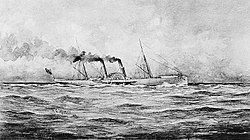
While a large proportion of blockade runners did manage to evade the Spousal relationship ships,[13] as the blockade matured, the type of ship most probable to discover success in evading the naval cordon was a small-scale, light ship with a short typhoon—qualities that facilitated blockade running simply were poorly suited to carrying large amounts of heavy weaponry, metals, and other supplies desperately needed by the South. They were as well useless for exporting the large quantities of cotton that the South needed to sustain its economy.[14] To be successful in helping the Confederacy, a occludent runner had to make many trips; eventually, well-nigh were captured or sunk. Still, five out of half dozen attempts to evade the Union blockade were successful. During the war, some 1,500 blockade runners were captured or destroyed.[13]
Ordinary freighters were as well slow and visible to escape the Navy. The blockade runners therefore relied mainly on new steamships built in Great britain with depression profiles, shallow draft, and high speed. Their paddle-wheels, driven past steam engines that burned smokeless anthracite coal, could make 17 kn (31 km/h; twenty mph). Because the Due south lacked sufficient sailors, skippers and shipbuilding capability, the runners were by and large built, commanded and manned of officers and sailors of the British Merchant Marine.[15] The profits from blockade running were loftier as a typical blockade runner could make a profit equal to about $ane million U.S dollars in 1981 values from a single voyage.[15] Private British investors spent perhaps £50 million on the runners ($250 one thousand thousand in U.Due south. dollars, equivalent to about $2.five billion in 2006 dollars). The pay was high: a Royal Navy officer on exit might earn several thousand dollars (in gold) in bacon and bonus per circular trip, with ordinary seamen earning several hundred dollars.
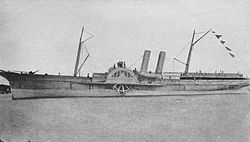
The occludent runners were based in the British islands of Bermuda and the Bahamas, or Havana, in Spanish Republic of cuba. The goods they carried were brought to these places by ordinary cargo ships, and loaded onto the runners. The runners and then ran the gauntlet betwixt their bases and Confederate ports, some 500–700 mi (800–i,130 km) apart. On each trip, a runner carried several hundred tons of compact, high-value cargo such as cotton, turpentine or tobacco outbound, and rifles, medicine, brandy, lingerie and coffee inbound. Ofttimes they besides carried mail. They charged from $300 to $1,000 per ton of cargo brought in; two round trips a calendar month would generate perhaps $250,000 in acquirement (and $80,000 in wages and expenses).
Blockade runners preferred to run past the Union Navy at night, either on moonless nights, before the moon rose, or after it set. Equally they approached the coastline, the ships showed no lights, and sailors were prohibited from smoking. Likewise, Union warships covered all their lights, except maybe a faint light on the commander's ship. If a Marriage warship discovered a blockade runner, information technology fired signal rockets in the direction of its course to alarm other ships. The runners adapted to such tactics by firing their own rockets in different directions to confuse Marriage warships.[xvi]
In Nov 1864, a wholesaler in Wilmington asked his amanuensis in the Bahamas to stop sending so much chloroform and instead send "essence of cognac" considering that perfume would sell "quite high". Confederate supporters held rich blockade runners in contempt for profiteering on luxuries while the soldiers were in rags. On the other hand, their bravery and initiative were necessary for the rebellion's survival, and many women in the dorsum state flaunted imported $x gewgaws and $50 hats to demonstrate the Spousal relationship had failed to isolate them from the outer earth. The government in Richmond, Virginia, eventually regulated the traffic, requiring half the imports to be munitions; it fifty-fifty purchased and operated some runners on its own account and made sure they loaded vital war goods. By 1864, Lee'south soldiers were eating imported meat. Blockade running was reasonably safe for both sides. Information technology was not illegal under international law; captured strange sailors were released, while Confederates went to prison camps. The ships were unarmed (the weight of cannon would slow them downwards), so they posed no danger to the Navy warships.
I instance of the lucrative (and brusque-lived) nature of the blockade running merchandise was the ship Banshee, which operated out of Nassau and Bermuda. She was captured on her seventh run into Wilmington, N Carolina, and confiscated by the U.Southward. Navy for utilise as a blockading ship. Nonetheless, at the time of her capture, she had turned a 700% profit for her English owners, who quickly commissioned and built Banshee No. 2, which before long joined the house'south fleet of blockade runners.[17]
In May 1865, CSS Lark became the last Amalgamated ship to sideslip out of a Southern port and successfully evade the Matrimony blockade when she left Galveston, Texas, for Havana.[eighteen]
Touch on on the Confederacy [edit]
The Union blockade was a powerful weapon that eventually ruined the Southern economy, at the cost of very few lives.[19] The mensurate of the occludent's success was not the few ships that slipped through, but the thousands that never tried it. Ordinary freighters had no reasonable hope of evading the occludent and stopped calling at Southern ports. The interdiction of coastal traffic meant that long-distance travel depended on the rickety railroad organisation, which never overcame the devastating impact of the occludent. Throughout the war, the South produced enough food for civilians and soldiers, just it had growing difficulty in moving surpluses to areas of scarcity and famine. Lee's army, at the end of the supply line, near always was short of supplies every bit the war progressed into its terminal two years.
When the blockade began in 1861, it was only partially constructive. It has been estimated that but ane in 10 ships trying to evade the blockade were intercepted. Nonetheless, the Marriage Navy gradually increased in size throughout the war, and was able to drastically reduce shipments into Amalgamated ports. Past 1864, one in every iii ships attempting to run the blockade were being intercepted.[20] In the final 2 years of the war, the only ships with a reasonable take chances of evading the blockade were blockade runners specifically designed for speed.[21] [22]
The blockade almost totally choked off Southern cotton exports, which the Confederacy depended on for hard currency. Cotton exports vicious 95%, from x million bales in the three years prior to the state of war to only 500,000 bales during the blockade menstruation.[13] The blockade also largely reduced imports of food, medicine, state of war materials, manufactured goods, and luxury items, resulting in severe shortages and aggrandizement. Shortages of bread led to occasional bread riots in Richmond and other cities, showing that patriotism was not sufficient to satisfy the daily demands of the people. Land routes remained open up for cattle drovers, only afterward the Spousal relationship seized control of the Mississippi River in summer 1863, information technology became impossible to ship horses, cattle and swine from Texas and Arkansas to the eastern Confederacy. The blockade was a triumph of the Wedlock Navy and a major factor in winning the war.
A significant secondary bear on of the naval blockade was a resulting scarcity of salt throughout the South. In Antebellum times, returning cotton-shipping ships were frequently ballasted with salt, which was bountifully produced at a prehistoric dry out lake near Syracuse, New York, simply which had never been produced in significant quantity in the Southern States. Salt was necessary for curing meat; its lack led to significant hardship in keeping the Confederate forces fed as well as severely impacting the populace. In addition to blocking salt from being imported into the Confederacy, Union forces actively destroyed attempts to build salt-producing facilities at Avery Island, Louisiana (destroyed in 1863 by Wedlock forces under General Nathaniel P. Banks), outside the bay at Port St. Joe, Florida (destroyed in 1862 by the Union transport Kingfisher), at Darien, Georgia, at Saltville, Virginia (captured by Union forces in Dec 1864), and various sites subconscious in marshes and bayous.[23]
Touch on International Trade [edit]
The southern cotton manufacture began to heavily influence the British economy. Cotton fiber was a highly profitable cash crop, known in the 19th century as "white gold".[24] On the eve of the war, i,390,938,752 pounds weight of cotton fiber were imported into Great U.k. in 1860. Of this, the United States supplied ane,115,890,608 pounds, or well-nigh 5-sixths of the whole.[25] Not only was Uk aware of the bear on of Southern cotton, but and then was the South. They were confident that their industry held large power, so much, that they referred to their industry equally "Rex Cotton fiber." This slogan was used to declare its supremacy in America. On the floor of the U.S. Senate, Senator James Henry Hammond declaimed (March 4, 1858): "Yous dare non brand war upon cotton! No power on earth dares make war upon it. Cotton is king."[26] The South proclaimed that many domestic and even some international markets depended and so heavily on their cotton, that no one would dare spark tensions with the South. They also viewed this slogan as their reasoning behind why they should achieve their efforts in seceding from the Wedlock. The Southern Cotton industry was and then confident in the power of cotton fiber diplomacy, that without warning, they refused to export cotton for i day.
Imagining an overwhelming response of pleas for their cotton wool, the Southern cotton industry experienced quite the opposite. With the decisions of Lincoln and the lack of intervention on Great britain'due south office, the S was officially blockaded. Following the U.S. proclamation of its intention to establish an official blockade of Confederate ports, foreign governments began to recognize the Confederacy as a belligerent in the Civil War.[27] Great U.k. declared belligerent condition on May 13, 1861, followed past Spain on June 17 and Brazil on Baronial one. This was the first glimpse of failure for the Amalgamated Due south.
The conclusion to occludent Southern port cities took a large toll on the British economy just they weighed their consequences. United kingdom had a good amount of cotton fiber stored upward in warehouses in several locations that would provide for their fabric needs for some fourth dimension. Simply eventually Bully United kingdom began to see the effects of the blockade, "the blockade had a negative impact on the economies of other countries. Fabric manufacturing areas in Britain and France that depended on Southern cotton entered periods of loftier unemployment..." in the so-called Lancashire Cotton Famine.[28] Nearly 80% of the cotton used in the British textile mills came from the South, and the scarcity of cotton acquired by the blockade caused the toll of cotton to rapidly rise by 150% past the summertime of 1861.[24] The article written in the New York Times further proves that United kingdom was enlightened of the influence of cotton in their empire, "Nearly one million of operatives are employed in the manufacture of cotton in U.k., upon whom, at least five or half-dozen millions more depend for their daily subsistence. It is no exaggeration to say, that 1-quarter of the inhabitants of England are direct dependent upon the supply of cotton wool for their living."[29] Despite these consequences, Great United kingdom concluded that their decision was crucial in terms of reaching abolition of slavery in the United states.
The occludent led to Egypt replacing the South every bit United kingdom's principle source of cotton wool.[24] Likewise, Egyptian cotton replaced American cotton equally the principle source of cotton fiber for the textile mills of French republic and the Austrian empire not just for the civil state of war, but for the balance of the 19th century.[24] In 1861, just 600,000 cantars (one cantar being the equivalent of 100 pounds) of cotton fiber were exported from Egypt; by 1863 Egypt had exported 1.three million cantars of cotton.[24] Virtually 93% of the taxation acquirement collected by the Egyptian state came from taxing cotton while every landowner in the Nile river valley had started to grow cotton.[24] The vast majority of the land in the Nile river valley were owned by a clique of wealthy families of Turkish, Albanian and Circassian origin, known in Arab republic of egypt every bit the Turco-Circassian elite and to foreigners as the pasha course as near of the landowners usually had the Ottoman title of pasha (the equivalent of a title of nobility). The fellaheen (peasantry) became the subject of a ruthless system of exploitation as the landowners pressed the fellaheen to grow cotton instead of food, settling a bout of inflation caused by the shortage of nutrient every bit more and more than land was devoted to growing cotton wool.[24] The wealth created by the cotton fiber boom acquired by the Union blockade led to the redevelopment of much of Cairo and Alexandria equally the much of the medieval cores of both cities were razed to make way for modernistic buildings.[24] The cotton boom attracted a significant of foreign businessmen to Egypt, of which the largest number were Greeks.[24] The wealth created by the cotton boom in Egypt was ended past the terminate of the occludent in 1865, which allowed the cotton wool from the South to ultimately reenter the globe market place, helping to lead to Arab republic of egypt's bankruptcy in 1876.[24]
Confederate response [edit]

The Confederacy constructed torpedo boats, tending to exist small, fast steam launches equipped with spar torpedoes, to attack the blockading fleet. Some torpedo boats were refitted steam launches; others, such as the CSS David class, were purpose-built. The torpedo boats tried to assault under comprehend of nighttime by ramming the spar torpedo into the hull of the blockading ship, and so backing off and detonating the explosive. The torpedo boats were not very effective and were easily countered past simple measures such as hanging chains over the sides of ships to foul the screws of the torpedo boats, or encircling the ships with wooden booms to trap the torpedoes at a distance.
One historically notable naval action was the attack of the Confederate submarine H. Fifty. Hunley, a mitt-powered submarine launched from Charleston, South Carolina, confronting Spousal relationship blockade ships. On the night of 17 Feb 1864, Hunley attacked Housatonic. Housatonic sank with the loss of five crew; Hunley also sank, taking her coiffure of eight to the bottom.
Major engagements [edit]
The get-go victory for the U.Southward. Navy during the early phases of the blockade occurred on 24 April 1861, when the sloop Cumberland and a small flotilla of support ships began seizing Confederate ships and privateers in the vicinity of Fort Monroe off the Virginia coastline. Within the next ii weeks, Flag Officer Garrett J. Pendergrast had captured xvi enemy vessels, serving early on notice to the Amalgamated War Department that the blockade would be constructive if extended.[thirty]
Early battles in support of the blockade included the Blockade of the Chesapeake Bay,[31] from May to June 1861, and the Blockade of the Carolina Coast, Baronial–December 1861.[32] Both enabled the Wedlock Navy to gradually extend its blockade southward forth the Atlantic seaboard.
In early March 1862, the blockade of the James River in Virginia was gravely threatened by the showtime ironclad, CSS Virginia in the dramatic Boxing of Hampton Roads. Merely the timely entry of the new Union ironclad Monitor forestalled the threat. Two months afterward, Virginia and other ships of the James River Squadron were scuttled in response to the Wedlock Regular army and Navy advances.
The port of Savannah, Georgia, was effectively sealed by the reduction and surrender of Fort Pulaski on 11 Apr.[33]
The largest Amalgamated port, New Orleans, Louisiana, was ill-suited to blockade running since the channels could exist sealed by the U.S. Navy. From 16–22 April, the major forts below the city, Forts Jackson and St. Philip were bombarded by David Dixon Porter'south mortar schooners. On 22 April, Flag Officeholder David Farragut's armada cleared a passage through the obstructions. The fleet successfully ran past the forts on the morning of 24 April. This forced the surrender of the forts and New Orleans.[34]
The Battle of Mobile Bay on 5 August 1864 closed the final major Confederate port in the Gulf of Mexico.

"The Battle of Mobile Bay" past Louis Prang
In December 1864, Marriage Secretary of the Navy Gideon Welles sent a strength confronting Fort Fisher, which protected the Confederacy'due south admission to the Atlantic from Wilmington, North Carolina, the last open Confederate port on the Atlantic Coast.[35] The first attack failed, but with a change in tactics (and Matrimony generals), the fort fell in January 1865, closing the last major Confederate port.
As the Union fleet grew in size, speed and sophistication, more ports came under Federal control. After 1862, only three ports east of the Mississippi—Wilmington, Due north Carolina; Charleston, S Carolina; and Mobile, Alabama—remained open for the 75–100 occludent runners in business organisation. Charleston was shut downwards by Admiral John A. Dahlgren'south South Atlantic Blockading Squadron in 1863. Mobile Bay was captured in August 1864 by Admiral David Farragut. Blockade runners faced an increasing risk of capture—in 1861 and 1862, one sortie in 9 ended in capture; in 1863 and 1864, one in 3. By war'south end, imports had been high-strung to a trickle as the number of captures came to 50% of the sorties. Some 1,100 blockade runners were captured (and another 300 destroyed). British investors frequently made the mistake of reinvesting their profits in the merchandise; when the war ended they were stuck with useless ships and rapidly depreciating cotton. In the concluding accounting, peradventure one-half the investors took a profit, and half a loss.
The Union victory at Vicksburg, Mississippi, in July 1863 opened upwardly the Mississippi River and effectively cut off the western Confederacy as a source of troops and supplies. The fall of Fort Fisher and the city of Wilmington, N Carolina, early in 1865 closed the last major port for blockade runners, and in quick succession Richmond was evacuated, the Ground forces of Northern Virginia disintegrated, and General Lee surrendered. Thus, near economists give the Matrimony blockade a prominent role in the effect of the war. (Elekund, 2004)
Squadrons [edit]
The Union naval ships enforcing the occludent were divided into squadrons based on their area of operation.[36]
Atlantic Blockading Squadron [edit]
The Atlantic Blockading Squadron was a unit of the U.s.a. Navy created in the early days of the American Ceremonious War to enforce a blockade of the ports of the Amalgamated States. It was originally formed in 1861 equally the Coast Blockading Squadron before beingness renamed May 17, 1861. Information technology was separate the same twelvemonth for the creation of the North Atlantic Blockading Squadron and the South Atlantic Blockading Squadron.
N Atlantic Blockading Squadron [edit]
The North Atlantic Blockading Squadron was based at Hampton Roads, Virginia, and was tasked with coverage of Virginia and North Carolina. Its official range of performance was from the Potomac River to Cape Fear in Due north Carolina. It was tasked primarily with preventing Confederate ships from supplying troops and with supporting Union troops. Information technology was created when the Atlantic Blockading Squadron was split between the North and Due south Atlantic Blockading Squadrons on 29 Oct 1861. After the stop of the war, the squadron was merged into the Atlantic Squadron on 25 July 1865.[36]
Commanders [edit]
| Squadron Commander | From | To |
|---|---|---|
| Flag Officer Louis K. Goldsborough | 18 September 1861[37] | 4 September 1862 |
| Acting Rear Admiral[37] Samuel Phillips Lee | five September 1862[37] | xi October 1864 |
| Rear Admiral David Dixon Porter | 12 Oct 1864 | 27 Apr 1865 |
| Acting Rear Admiral[37] William Radford | 28 April 1865[37] | 25 July 1865 |
South Atlantic Blockading Squadron [edit]
The South Atlantic Blockading Squadron was tasked primarily with preventing Confederate ships from supplying troops and with supporting Union troops operating between Cape Henry in Virginia down to Cardinal Westward in Florida. It was created when the Atlantic Blockading Squadron was split between the North and South Atlantic Blockading Squadrons on 29 October 1861. Subsequently the stop of the war, the squadron was merged into the Atlantic Squadron on 25 July 1865.
Commanders [edit]
| Squadron Commander | From | To |
|---|---|---|
| Rear Admiral Samuel Francis Du Pont | 18 September 1861[37] | five July 1863 |
| Rear Admiral John A. Dahlgren | 6 July 1863[37] | 25 July 1865 |
Gulf Blockading Squadron [edit]
The Gulf Blockading Squadron was a squadron of the U.s.a. Navy in the early function of the War, patrolling from Primal W to the Mexican border. The squadron was the largest in operation. Information technology was divide into the Due east and West Gulf Blockading Squadrons in early 1862 for more than efficiency.
Commanders [edit]
| Squadron Commander | From | To |
|---|---|---|
| Flag Officer William Mervine | 6 May 1861 | 21 September 1861 |
| Flag Officer William McKean | 22 September 1861 | 20 January 1862 |
East Gulf Blockading Squadron [edit]
The E Gulf Blockading Squadron, assigned the Florida coast from east of Pensacola to Cape Canaveral, was a small command.[38] The squadron was headquartered in Key Westward and was supported past a U.South. Navy coal depot and storehouse built during 1856–61.[39]
Commanders [edit]
| Squadron Commander[forty] | From | To |
|---|---|---|
| Flag Officeholder William McKean | 20 January 1862 | iii June 1862 |
| Flag Officer James L. Lardner | 4 June 1862 | 8 December 1862 |
| Acting Rear Admiral Theodorus Bailey | 9 December 1862 | 6 August 1864 |
| Captain Theodore P. Greene (commander pro tem) | 7 Baronial 1864 | eleven October 1864 |
| Interim Rear Admiral Cornelius Stribling | 12 October 1864 | 12 June 1865 |
West Gulf Blockading Squadron [edit]
The West Gulf Blockading Squadron was tasked primarily with preventing Confederate ships from supplying troops and with supporting Wedlock troops along the western half of the Gulf Declension, from the mouth of the Mississippi to the Rio Grande and south, beyond the edge with Mexico. Information technology was created early on in 1862 when the Gulf Blockading Squadron was split between the Due east and Due west. This unit was the main military force deployed past the Marriage in the capture and cursory occupation of Galveston, Texas in 1862.
Commanders [edit]
| Squadron Commander[40] | From | To |
|---|---|---|
| Rear Admiral David Farragut | 20 Jan 1862 | 29 November 1864 |
| Commodore James Due south. Palmer | 30 November 1864 | 22 February 1865 |
| Acting Rear Admiral Henry Grand. Thatcher | 23 February 1865 | 12 June 1865 |
Retrospective consideration [edit]
Afterward the state of war, former Confederate Navy officer and Lost Crusade proponent Raphael Semmes contended that the announcement of a blockade had carried de facto recognition of the Amalgamated States of America as an independent national entity since countries practice not blockade their own ports merely rather shut them (See Boston Port Human action).[41] Under international constabulary and maritime police force, still, nations had the right to stop and search neutral ships in international waters if they were suspected of violating a blockade, something port closures would non allow. In an endeavor to avoid conflict between the Usa and Uk over the searching of British merchant vessels thought to be trading with the Confederacy, the Matrimony needed the privileges of international police force that came with the declaration of a blockade.
Yet Semmes contends that by finer declaring the Confederate States of America to be belligerents—rather than insurrectionists, who under international law were not eligible for recognition by strange powers—Lincoln opened the way for Britain and France to potentially recognize the Confederacy. Britain's announcement of neutrality was consistent with the Lincoln Administration's position—that under international law the Confederates were belligerents—and helped legitimize the Confederate States of America's national right to obtain loans and purchase artillery from neutral nations. The British proclamation likewise formally gave Uk the diplomatic correct to hash out openly which side, if any, to support.[13]
See also [edit]
- Bibliography of American Civil War naval history
- Amalgamated Navy
- Blockade postal service of the Confederacy
References [edit]
- ^ "History Place". History Identify. Retrieved 8 June 2010.
- ^ Time-Life, p. 29.
- ^ Fourth dimension-Life, p. 31.
- ^ "National Park Service". nps.gov. Retrieved eight June 2010.
- ^ U.S Naval Blockade
- ^ Soley, James Russel, The Occludent and the Cruisers
- ^ Davis, Kenneth C. Don't Know Much Almost The Civil State of war. ISBN 0688118143
- ^ "Blockade essays" (PDF). Archived from the original (PDF) on sixteen July 2010. Retrieved viii June 2010.
- ^ Appletons' annual cyclopaedia and annals of of import events of the year: 1862. New York: D. Appleton & Company. 1863. p. 604.
- ^ "U.S. Navy, Maritime History of Massachusetts--A National Register of Historic Places Travel Itinerary". nps.gov . Retrieved 31 October 2015.
- ^ Time-Life, p. 33.
- ^ Barrett, John K. (1995). The Civil War in North Carolina. ISBN978-0807845202 . Retrieved eight June 2010 – via Google Books.
- ^ a b c d "Lincoln biography". Americanpresident.org. Archived from the original on 13 Oct 2006. Retrieved 8 June 2010.
- ^ Wyllie, 2007 p. 184
- ^ a b Porter 1981, p. 134.
- ^ "The Civil War On The Fringe: Blockade Runners". Something about Everything Military: America At War: The Civil State of war. Archived from the original on 5 January 2011.
- ^ Time-Life, p. 95.
- ^ "Galveston Weekly News, April 26, 1865". Nautarch.tamu.edu. 3 July 2000. Retrieved 8 June 2010.
- ^ Saxe, David Warren (2006). Land and Freedom I: A Chronology of ... ISBN978-1599424057 . Retrieved 8 June 2010 – via Google Books.
- ^ "American Civil War: The Occludent and the State of war at Sea". historyofwar.org . Retrieved 31 October 2015.
- ^ Bulloch, James Dunwody (1884). The secret service of the Confederate States in Europe, or, How the Confederate cruisers were equipped. G.P. Putnam's Sons, New York. p. 460.
- ^ Merli, Frank J. (1970). Britain and the Amalgamated Navy, 1861–1865. Indiana Academy Press, Indiana. p. 342. ISBN 0-253-21735-0.
- ^ Anne Ewbank (28 September 2018). "How Salt Helped Win the Civil War". Atlas Obscura . Retrieved nineteen February 2021.
- ^ a b c d e f g h i j Schwartzstein, Peter (1 August 2016). "How the American Civil State of war Built Egypt'due south Vaunted Cotton fiber Manufacture and Changed the State Forever The boxing between the U.S. and the Confederacy affected global merchandise in astonishing ways". The Smithsonian. Retrieved 14 February 2022.
- ^ "England and the Cotton wool Supply". New York Times, June 1, 1861 . Retrieved 13 Oct 2016.
- ^ Underwood, Rodman L. (18 March 2008). Waters of Discord: The Union Blockade of Texas During the Ceremonious War. McFarland. p. 103. ISBN978-0-7864-3776-iv.
- ^ "Milestones: 1861–1865 - Office of the Historian". U.South. Section of Land . Retrieved 13 October 2016.
- ^ "." . . . "Milestones: 1861–1865". U.S. Department of State. Office of the Historian. Retrieved thirteen Oct 2016.
{{cite spider web}}: CS1 maint: numeric names: authors list (link) - ^ "England and the Cotton Supplu". The New York Times. one June 1861. Retrieved 13 October 2016.
- ^ Time-Life, page 24.
- ^ "National Park Service". nps.gov. Retrieved eight June 2010.
- ^ "National Park Service". nps.gov. Retrieved eight June 2010.
- ^ NPS.gov, National Park Service Summary Siege of Fort Pulaski
- ^ NPS.gov, National Park Service Summary Battle of Forts Jackson and St. Philips
- ^ "Amphibious Warfare: Nineteenth Century". Exwar.org. Archived from the original on ii Oct 2009. Retrieved 8 June 2010.
- ^ a b Robert 1000 Browning JR (1993). From Greatcoat Charles to Cape Fearfulness: the ... ISBN978-0817306793 . Retrieved viii June 2010 – via Google Books.
- ^ a b c d e f g Ceremonious War Desk Reference, p. 550.
- ^ Anderson, 1989 p. 118
- ^ Diane Greer and Mary Evans (twenty March 1972). "National Annals of Historic Places Inventory/Nomination: U. S. Coast Baby-sit Headquarters, Keywest Station / U. S. Navy Coal Depot and Storehouse; also, Building #ane". National Park Service. Retrieved five April 2017. With two photos from 1972.
- ^ a b Civil War Desk Reference, p. 551.
- ^ "Jenkins essay". Wideopenwest.com. Archived from the original on 26 May 2009. Retrieved 8 June 2010.
Bibliography [edit]
- Anderson, Bern (1989). By Ocean and by River The Naval History of the Civil . Da Capo Press, New York. p. 342. ISBN978-0-615-17222-4. Url
- Browning, Robert Yard. Jr. (1993). From Greatcoat Charles to Cape Fright. The North Atlantic Blockading Squadron during the Civil State of war. University of Alabama Press. p. 472. Url
- —— (2002). Success is All That Was Expected. The Southward Atlantic Blockading Squadron during the Civil War. Washington DC: Brassley'southward. p. 432. ISBN978-one-57488-514-9. Url
- ——— (2015). Lincoln'southward Trident: The Westward Gulf Blockading Squadron during the Ceremonious War. Academy of Alabama Press. p. 700.
- Buker, George Due east. (1993). Blockaders, Refugees, and Contrabands: Civil War on Florida'south Gulf Declension, 1861–1865. University of Alabama Press. p. 235. Url
- Coker, P. C., Iii (1987). Charleston's Maritime Heritage, 1670–1865: An Illustrated History. CokerCraft Press. p. 314. Url
- Elekund, R.B.; Jackson, Grand.; J.D., Thornton (2004). The 'Unintended Consequences' of Confederate Trade Legislation. Eastern Economic Periodical. p. 123.
- Fowler, William G. (1990). Nether Two Flags: The American Navy in the Civil War. p. 123. ISBN978-0-393-02859-1.
- Greene, Jack (1998). Ironclads at State of war; Combined Publishing
- McPherson, James Chiliad., State of war on the Waters: The Union & Amalgamated Navies, 1861-1865 University of Due north Carolina Press, 2012, ISBN 978-0-8078-3588-3
- Porter, Due east.B. (1981). Sea Power: A Naval History. Annapolis: Naval Institute Press. ISBN0870216074.
- Surdam, David Thou. (2001). Northern Naval Superiority and the Economics of the American Civil State of war; University of S Carolina Printing
- Time-Life Books (1983) The Blockade: Runners and Raiders. The Civil War series; Fourth dimension-Life Books, ISBN 0-8094-4708-8.
- Vandiver, Frank Everson (1947). Confederate Blockade Running Through Bermuda, 1861–1865: Messages And Cargo Manifests, primary documents
- Wagner, Margaret E., Gallagher, Gary West. and Finkelman, Paul ed., (2002) The Library of Congress Ceremonious War Desk-bound Reference
Simon & Schuster, New York. ISBN 978-1-4391-4884-6 - Wise, Stephen R. (1991). Lifeline of the Confederacy: Blockade Running During the Civil War.
Univ of South Carolina Press. p. 403. ISBN978-0-87249-554-viii. Url - Wyllie, Arthur (2007). The Amalgamated States Navy.
Lulu.com. p. 466. ISBN978-0-615-17222-iv. [ cocky-published source? ] Url1 Url2 - Wynne, Nick & Cranshaw, Joe (2011). Florida Civil War Blockades
History Press, Charleston, SC, ISBN 978-1-60949-340-0.
Farther reading [edit]
- Calore, Paul (2002). Naval Campaigns of the Civil War. McFarland. p. 232. Url
- Tucker, Spencer (2010). The Ceremonious War Naval Encyclopedia, Book 1.
ABC-CLIO. p. 829. ISBN978-1-59884-338-five. Url
External links [edit]
- National Park Service listing of campaigns
- Book review: Lifeline of the Confederacy
- Unintended Consequences of Confederate Trade Legislation
- The Hapless Anaconda: Matrimony Occludent 1861–1865
- Sabine Laissez passer and Galveston Were Successful Occludent-Running Ports By W. T. Block
- Civil War Blockade Arrangement
- David Yard. Surdam, Northern Naval Superiority and the Economics of the American Ceremonious War ISBN one-57003-407-ix
- "The Egotistigraphy", by John Sanford Barnes. An autobiography, including his Ceremonious War Union Navy service on a send participating in the blockade, USS Wabash, privately printed 1910. Net edition edited by Susan Bainbridge Hay 2012
Source: https://en.wikipedia.org/wiki/Union_blockade
0 Response to "Union Ships Blocking Detroit and Harbor Try Again Union Ships Blocking the Charleston Harbor"
Post a Comment